IN-DEPTH READING
The scourging: texts, history, cloth, and the limits of reconstruction
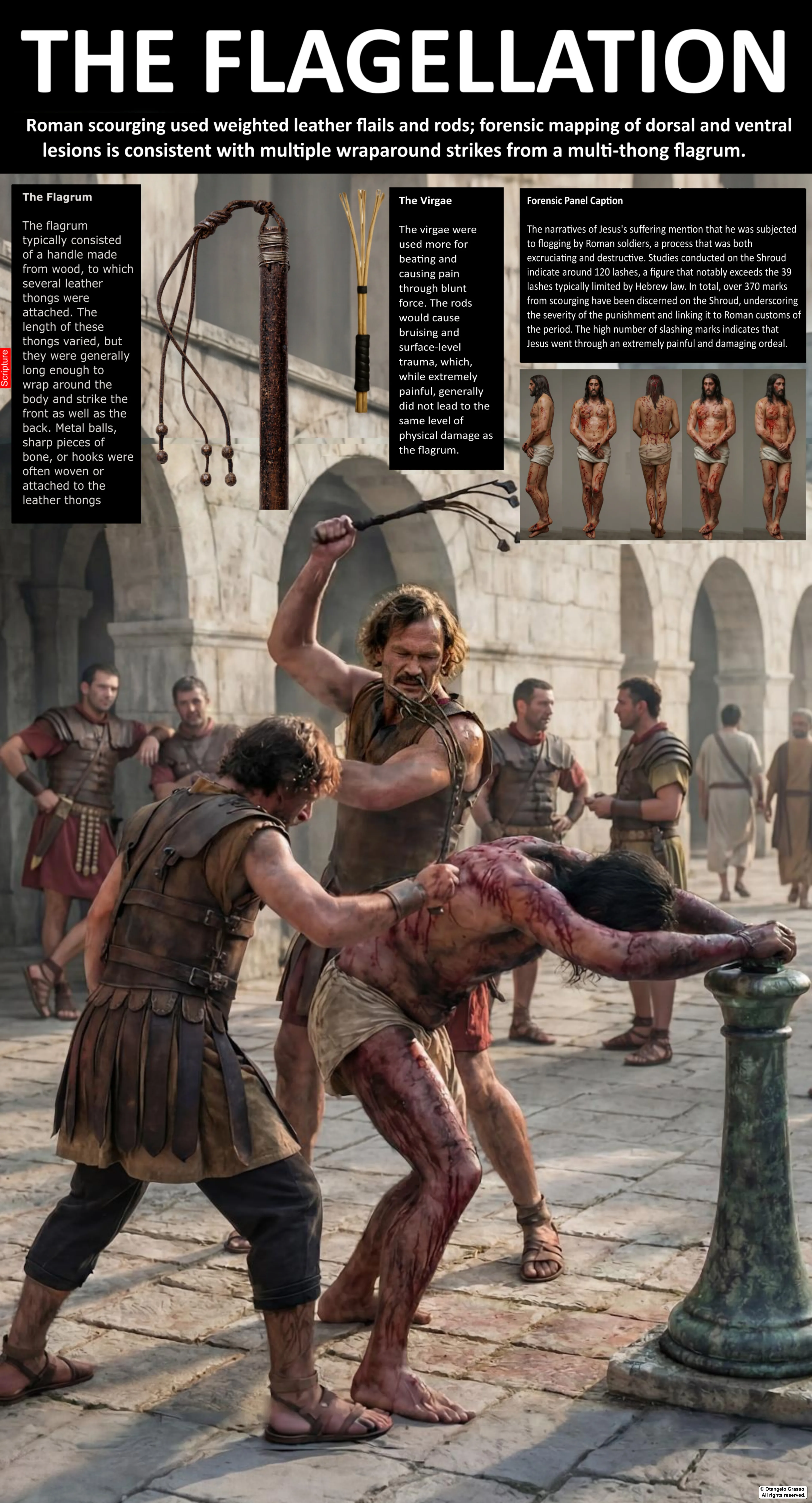
The Passion narratives say that Jesus was flogged under Pontius Pilate. The Shroud of Turin bears clusters of marks that many investigators have compared with scourging. That comparison is historically important, but it does not by itself identify the cloth, the person, the weapon, or the exact event. This chapter follows the evidence in order: what each Gospel actually says; what Roman punishment can be reconstructed from ancient sources; why the Jerusalem location is debated; what photographers and researchers reported on the Shroud; and which medical and blood-transfer claims remain hypotheses.
The author’s books and papers supplied material for this account, including images and a proposed event reconstruction. They are used here as research sources. Where their conclusions move beyond the observations or conflict with other studies, the article says so directly. In particular, the exact date and hour, the exact room and route, a weighted multi-thong scourge, an exact count of blows, serum identification from appearance alone, and a clinical diagnosis of the man represented are not established facts.
1. What the four Gospels say—and what they leave open
All four canonical Gospels place Jesus’ death under Roman authority and associate the final events with Pilate. They do not give a single, fully harmonized sequence of the flogging. Matthew says Pilate released Barabbas, had Jesus flogged, and handed him over for crucifixion (Matthew 27:26–31). Mark likewise places the flogging after Pilate’s decision to satisfy the crowd and before the soldiers lead Jesus into the praetorium, where they mock him (Mark 15:15–20). These two accounts make the flogging part of the execution handover.
John presents a different narrative order. Pilate has Jesus flogged, the soldiers dress and mock him, and Pilate brings him out before the final exchange with the crowd (John 19:1–16). Luke does not narrate a Roman scourging in the same place in his sequence. Instead, Pilate says that he will have Jesus punished and release him (Luke 23:16, 22). Luke has already described guards mocking and striking Jesus while he was held before the Roman hearing (Luke 22:63–65). The Greek wording and narrative context differ: Luke’s proposed “discipline” is not by itself a detailed description of the execution scourging in Matthew and Mark.
These differences matter. A reconstruction that places every scene into one precise minute-by-minute schedule has to choose how to harmonize accounts that arrange events differently. The Gospels do not specify the hour of the flogging, the number of strokes, the number of soldiers applying them, whether the prisoner was standing or bent over, whether he was tied to a post, the design or material of the instrument, the exact courtyard, or whether the flogging was intended as a preliminary to execution or as Pilate’s attempted lesser punishment. They also do not describe the Shroud or identify any particular mark on it.
The accounts do say that the soldiers mocked Jesus as “King of the Jews.” Mark and Matthew locate the mockery within the praetorium complex, after the sentence and flogging in their narrative. John places mockery before the final sentence. The robe, crown of thorns, and blows with a reed or staff belong to the mockery scenes; these should not be collapsed into a technical account of the scourging itself. The narrative gives a religious and political episode, not an instrument inventory.
It is also necessary to keep the night-time abuse in Luke distinct from the Roman event. Luke 22:63–65 describes guards striking, blindfolding, and taunting Jesus in custody. Some Shroud writers propose that this produced an earlier set of injuries later overlain by Roman scourge marks. That sequence is possible as a narrative reconstruction, but the cloth cannot independently assign one group of stains to Caiaphas’s guards and another to Pilate’s executioners. The Gospels never connect a particular visible mark with either episode.1
2. Date, hour, and the proposed chronology
The user’s reconstruction places the scourging on Friday, April 3, AD 33, in the late morning. April 3, AD 33 is a serious proposal in the literature, often associated with astronomical and calendrical arguments about the Jewish Passover and a lunar eclipse. It is not a date named in the Gospels. Scholars have proposed more than one possible year and day, and some favor Friday, April 7, AD 30. The question depends on how one correlates the Gospel chronology, Passover dating, and the ancient calendar. The precise date should therefore be presented as a proposed chronology, not as a settled timestamp.23
“Late morning” is still more specific. John gives a time reference in the trial narrative, but the Gospel accounts do not timestamp the flogging itself in a way that fixes its start or duration. Mark’s “third hour” for the crucifixion and John’s time reference have prompted discussion about ancient timekeeping, narrative sequence, and textual transmission. No source says the flogging began at a particular modern-clock hour. The article therefore uses “the morning of the execution day” as a broad narrative placement and labels any narrower hour as conjectural.
The proposed itinerary in the supplied text—arrest, night custody, an early hearing, movement to Pilate, a possible transfer to Herod Antipas, return, sentence, scourging, mockery, and departure—draws on details distributed across the four accounts. Luke alone reports a transfer to Herod Antipas and a return to Pilate (Luke 23:6–12). The other Gospels omit that episode. Its inclusion changes the timing and movement reconstruction, so a reader should be able to see which steps come from which Gospel and which are inferred.
3. Where was Pilate’s praetorium?
Praetorium can refer to a governor’s headquarters or residence, among other related uses. The Gospel narratives do not name “the Antonia Fortress,” the modern Via Dolorosa, the Tower of David, the Jaffa Gate, or a specific palace courtyard as the place of Jesus’ hearing and scourging. Mark 15:16 calls the praetorium a palace or residence (aulē); John describes Pilate moving between an interior space and an exterior place of judgment. Those descriptions fit a substantial administrative residence, but do not locate it on a modern map.
The western palace built by Herod the Great is a strong historical candidate for Pilate’s Jerusalem headquarters. Philo, describing Pilate’s installation of shields dedicated to Tiberius, places official activity in Herod’s palace in Jerusalem. Josephus later describes the Roman governor Gessius Florus residing at the palace and conducting a tribunal in front of it; he separately describes the Antonia and military forces. Josephus’ account of Herod’s palace portrays a large, fortified complex in the Upper City. Together these sources establish the palace’s suitability and its use in Roman administration, but neither Philo nor Josephus says that Jesus was flogged there.45
The traditional Antonia identification is understandable: the fortress stood beside the Temple precinct and had a military role, making it a plausible place for troops to monitor festival crowds. Yet the specific identification of the surviving pavement near the Ecce Homo Arch as the pavement on which Pilate judged Jesus is disputed; much of the visible pavement is associated with the later Roman city of Aelia Capitolina. This weakens arguments that treat the extant pavement or arch as direct first-century witnesses. It does not prove that no Roman judicial or military activity ever occurred near Antonia.
The careful distinction is between a probable administrative setting and an exact episode location. Herod’s former western palace is a well-supported candidate for Pilate’s residence; a particular gate, pavement, room, column, or courtyard has not been established as the exact site of the scourging. The author’s downloadable reconstruction develops the western-palace proposal and a possible route toward Golgotha. It is an interpretive topographical study, not a contemporary record. Its own discussion acknowledges that street-by-street routes and the exact point of the tribunal are uncertain.6
The supplied reconstruction gives a distance of about 800 metres from the Temple’s Chamber of Hewn Stones to Herod’s Palace, and places the palace near the Jaffa Gate and the Tower of David. Those are modern route estimates, not details reported in a Passion source. The tradition that Jesus was taken from the Chamber of Hewn Stones is not stated in the Gospels. The surviving archaeological record does not identify the path Jesus walked from the high-priestly hearing to Pilate. For that reason, the article does not narrate the 800 metres as a documented journey.
4. Roman scourging: practice and the uncertain whip
Roman corporal punishment could be severe, public, and humiliating. Ancient texts describe people being stripped, beaten, or scourged, and Roman executions could involve flogging. The degree and form depended on context, legal status, authority, and the purpose of the punishment. A passage about one violent episode in Alexandria, for example, can illustrate the brutality Roman officials might inflict; it does not establish the precise protocol used by Pilate in Jerusalem. It is safer to describe Roman scourging as a family of punitive practices than as one uniform, fully documented procedure.
Later discussions often distinguish fustigatio, flagellatio, and verberatio as escalating forms of beating. The terminology appears in Latin sources, but should not be turned into a simple universal three-level chart without attention to author, period, and context. The Gospel writers use Greek verbs meaning to flog or chastise; they do not specify that Pilate ordered a technical category called verberatio. Nor do the words themselves tell us what implement touched the body.
The common modern picture of a Roman flagrum is a short handle with several leather thongs carrying lead weights, bone pieces, or other hard objects. Some proposed reconstructions add hooks or sharp fragments and describe the ends as “scorpions.” Such implements are familiar in devotional art and popular retellings, but the surviving literary and archaeological evidence for the precise tool used in first-century Jerusalem is limited. Historian Andrea Nicolotti’s survey of the textual and material evidence concludes that most claims identifying a specific scourge design for Jesus cannot be securely substantiated. We should not claim that “the Roman flagrum” had one standard three-thong construction with two lead balls or sheep bones on each thong unless a particular artifact and its provenance are independently documented.7
In the author’s books, the visual similarity between paired marks on the Shroud and weighted scourge models motivates the hypothesis of a multi-thong whip. That is a reasonable question to investigate. But visual fit is not a unique identification: a pair of marks could result from more than one tool or transfer process, and a modern replica designed to reproduce the marks cannot independently prove which ancient tool caused them. The author’s own source review includes the caution attributed to Flavia Manservigi: historical scourging instruments may have produced similar marks, but the exact implement in Jesus’ case cannot be determined. The experimental comparison by Faccini and Fanti likewise reports that more than one type of whip can produce similar impressions; it narrows possibilities without identifying a unique historical weapon.89
The supplied text also proposes virgae, rods, as an earlier or additional instrument. Rods and switches are well attested as forms of corporal punishment, but a rod strike and a scourging mark cannot be assigned to separate episodes by appearance alone. The suggestion that Luke’s custody beating left one class of injuries and Pilate’s scourging another remains a hypothesis. The Greek word in Luke 22:63 is a general term for striking; it does not identify a Roman rod type or a location beneath Caiaphas’s house.
Nor does the “forty less one” rule establish a Roman lash count. Deuteronomy 25:1–3 limits a judicial beating within Israelite law, and 2 Corinthians 11:24 describes Paul receiving thirty-nine lashes from Jewish authorities. That is not a Roman statutory ceiling for a condemned prisoner. The Mishnah’s later discussion of the maximum similarly concerns Jewish disciplinary flogging, not Pilate’s order. The absence of a Roman number in the Gospels does not permit an exact count to be read off the cloth.
The familiar statement that scourging was “a legal preliminary to every Roman execution” is also too absolute. Ancient practice varied, and status or circumstances could alter punishment. In this specific Passion narrative, the Gospels report flogging in connection with Jesus’ execution. That is the secure textual claim. The exact legal instruction, whether the beating was intended to stop short of death, and how long it lasted are not specified.
5. What the Shroud’s marks look like
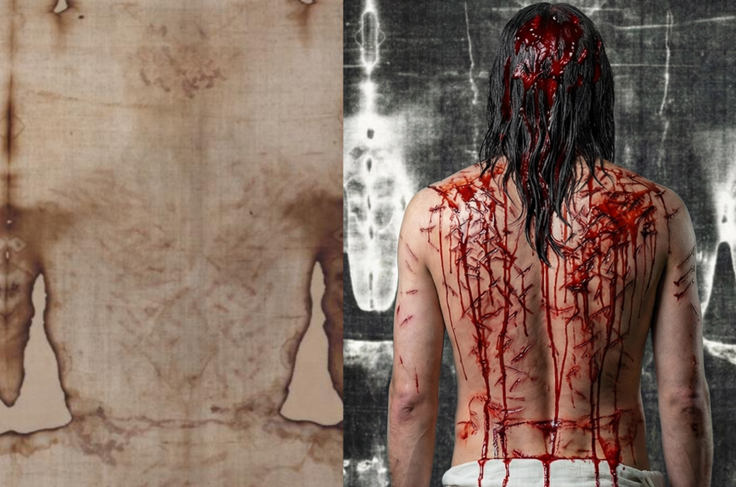
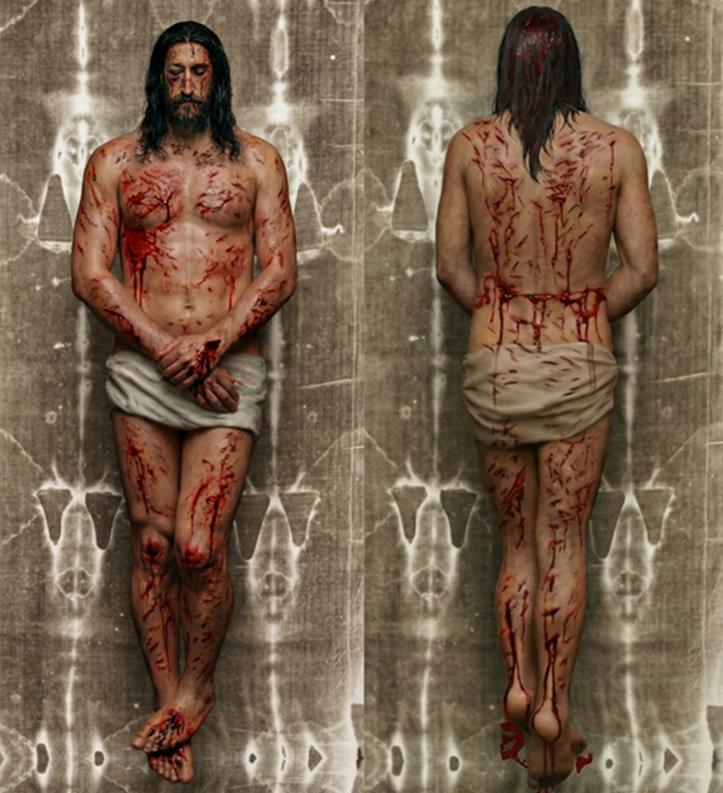
Photographs of the Shroud show scattered reddish-brown marks over the body image, especially on the back, buttocks, thighs, and legs, with marks also discussed on the front. Some are small paired or dumbbell-like forms; others are linear, blurred, overlapping, interrupted, or difficult to separate from other discolorations. The word “scourge” is therefore an interpretive label for a class of marks, not a direct observation of a weapon. It is useful to distinguish the visible shape from the explanation proposed for that shape.
The 1978 Shroud of Turin Research Project documented the cloth using several methods, including photography under visible and ultraviolet illumination. Miller and Pellicori’s published UV fluorescence survey records regional differences in fluorescence and absorption. In some areas, marks interpreted as scourges have sharply contrasting boundaries or fine scratch-like details; other features are faint or ambiguous. The photographs are a valuable record of the surface under specified conditions. They do not by themselves tell us whether every irregularity is a wound, a blood stain, a fiber feature, a burn-related change, or later contamination.1011
Faccini and Fanti examined the marks using image processing and compared Shroud patterns with impressions made by different implements on experimental material. They reported three broad morphological types in earlier work and argued that both a bundle of flexible rods and a flagrum-like tool could generate similar shapes. This matters because it challenges the idea that one dumbbell outline uniquely identifies one weapon. Their experiment is a comparative model: the experimental backing was not human skin, the tests do not recreate all aspects of an ancient beating, and resemblance does not determine the Shroud’s date or provenance.8
The author’s books collect earlier proposals by Giulio Ricci and others, including estimates of roughly 120 marks and larger totals exceeding 300 when multiple small features are included. These numbers are not interchangeable. A “mark” can mean a visible stain, one lobe, a pair, a presumed impact, a damaged region, or a mark on a particular side of the cloth. Image contrast, resolution, overlap, and inclusion rules change the result. The author’s own papers sometimes state a count of about 120, while the book also discusses counts above 350. Without a published, reproducible catalogue that lists each mark and the counting rule, neither number should be advertised as the settled number of lashes.
The marks’ distribution has inspired reconstructions involving one or two executioners standing behind or beside the victim, a forward bend over a low post, or turning the body to strike the front. A cloth image is two-dimensional; it does not preserve the moving body’s exact orientation. Inferences about number of scourgers, body position, direction, or sequence require a validated model that explains the entire mark distribution, not just selected examples. No Gospel supplies those details.
6. Why a count on the cloth cannot become a lash count
The estimate of “about 120” associated with Ricci is often repeated as if it were an instrument reading. It is instead an interpretation based on visual examination of selected marks. The greater totals in later books use broader criteria and include additional visible forms. Neither count derives from a surviving Roman record or a calibrated measurement of every impact. Because a single strike can leave several contact patches, and because marks can overlap or be hidden, even a perfect catalogue would count stains or possible contacts rather than necessarily count lash strokes.
The Shroud is also not a complete, high-resolution photograph of the body. Some areas are obscured by burn holes, patches, folds, weak image contrast, and changes from conservation or display. Interpretations of the buttocks and upper arms vary. The statement that the scourge marks “spare” a body region may reflect the visible image, but it cannot prove that no blows landed there: an absent image mark is not a reliable record of an absent injury.
Consequently, the numbers in the books are best treated as historiography: they show how investigators have tried to describe the pattern and how their assumptions differ. A stronger future account would publish the full-resolution image, mark-by-mark coordinates, classification rules, confidence levels, and independent counts by multiple observers. Until then, the total should be reported as disputed, not as a precise forensic census.
7. Blood, ultraviolet photography, and proposed serum margins
Blood interpretation on the Shroud has its own history of debate. Heller and Adler reported chemical and spectroscopic reactions consistent with blood-related material in sampled reddish areas. The broader 1978 investigation included multiple analytical methods, and Schwalbe and Rogers later summarized the project’s physical and chemical work. Walter McCrone, examining tape samples microscopically, argued that iron-oxide and vermilion particles supported an artist’s pigment explanation. These published positions differ in methods and in how they interpret limited samples. The existence of that debate should be visible in a serious account rather than compressed to “science proved every stain is blood.”121314
Even if blood is accepted in tested areas, that conclusion cannot automatically be extended to every small mark called a scourge. Sampling was selective and limited; the test result is tied to the sampled fibers and analytical method. A chemical finding about a sample does not establish who the blood came from, when it was deposited, whether it transferred from a body, or whether all nearby marks share the same origin.
Ultraviolet photographs have been used to argue that pale fluorescent rims around some blood-like marks are serum separated from clotted blood. Miller and Pellicori’s images are important documentation, but fluorescence is a response of materials to illumination, not a unique chemical assay. Some marks show conspicuous pale borders; others do not. The difference may reflect stain composition, amount, contact, cloth structure, environmental history, photography, or interpretation. A visible halo alone does not establish serum.
Modern forensic experiments on blood and serum under UV 365 nm illumination show that fluorescence and edge appearance depend on wavelength, sample composition, drying, temperature, humidity, and substrate. These experiments help identify variables that any explanation must account for. They are not tests of the Shroud itself. They cannot validate a specific ancient clotting-and-transfer sequence without a comparable sample and an agreed analytical method.171819
The author’s “Pre-Mortem and Post-Mortem Blood” paper proposes reading different stain morphologies as evidence for blood deposited before and after death. It acknowledges a central limitation: no established stand-alone test classifies an ancient bloodstain as pre-mortem or post-mortem. The paper’s “convergent constraint” approach is the author’s interpretive framework, and some of its conclusions—such as a systematic pre/post-mortem classification, identity of serum halos, and a blood-before-image sequence—are stronger than the directly measured observations alone support. It is valuable as a map of the author’s hypothesis and testable questions, not as an independent consensus report.20
Similarly, the author’s biochemical synthesis assembles claims about heme, proteins, bilirubin, creatinine, cell morphology, and stratigraphy. These claims need to be traced to the original sample, method, and paper each time. Some measurements were made decades ago on very small sample sets; some later interpretations are disputed; and the assertion that a specific biomarker proves extreme trauma or human origin is not equivalent to a validated forensic diagnosis. The paper itself identifies itself as AI-assisted. That is a reason to check its citations against the original literature, not a reason to ignore it or to treat its conclusion as peer-reviewed experimental data.21
8. Medical consequences: what is plausible, what is not diagnosable
Repeated blows with a sufficiently injurious instrument can cause pain, bruising, skin breaks, bleeding, swelling, and soft-tissue injury. Severe blood loss can contribute to weakness and circulatory shock. These are general physiological possibilities. They do not require the Shroud to identify a particular person, and they do not tell us how severe any single historical flogging was.
Edwards, Gabel, and Hosmer’s well-known 1986 JAMA article offers a retrospective medical discussion of the Gospel Passion narrative, including the effects of flogging and crucifixion. It is not an autopsy, contemporaneous medical report, or examination of the Shroud’s subject. Later scholarship has challenged particular assumptions in medical reconstructions of crucifixion, including confident claims that suffocation was the normal or primary mechanism of death. Medical models can clarify what is physiologically possible; they cannot turn a short narrative and an ambiguous cloth pattern into patient-specific observations.2223
The supplied reconstruction lists hemothorax, pneumothorax, pleural effusion, pulmonary contusion, cardiac injury, pericardial effusion, hyperkalemia, dehydration, cyanosis, asymmetrical chest movement, and shock. Each is a real clinical condition, but none is diagnosed by the Shroud’s scourge-like marks. A hemothorax requires evidence of blood in the pleural space; hyperkalemia requires a measured potassium concentration; cardiac trauma requires clinical or pathological evidence. The Gospel texts do not report these diagnoses, and a linen image cannot supply them. Listing a series of possible complications without evidence can make a reconstruction sound more certain and specific than it is.
What can be said responsibly is narrower: if a person was severely flogged, pain, bruising, laceration, and blood loss are plausible, with severity depending on instrument, force, duration, body condition, and access to care. The actual instrument, wound depth, volume of blood loss, vital signs, consciousness, and immediate medical consequences in this individual case are unknown. Do not read the proposed injuries in the author’s colored composite as a clinical chart.
9. Pillars, relic traditions, and the later memory of the event
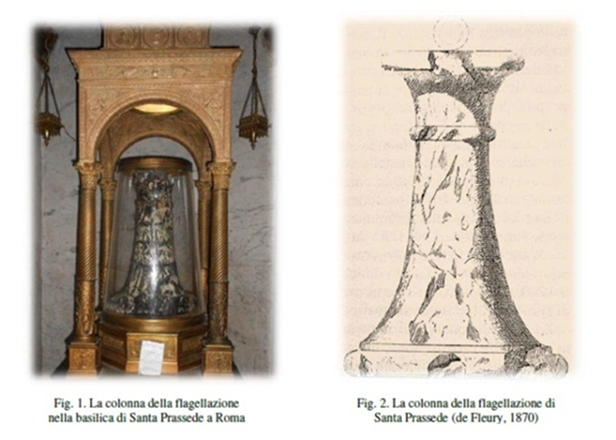
Christian devotion has preserved more than one object as the “pillar of the scourging.” The author’s Forensic Summary reproduces a photograph and a nineteenth-century drawing of the column venerated at Santa Prassede in Rome. The book also discusses a separate pillar tradition associated with Jerusalem and the house of Caiaphas. Such traditions are important evidence for how Christians remembered and localized the Passion. The objects’ devotional histories do not independently prove that either pillar was used by Jesus.
The distinction between Pilate’s scourging and the earlier guard abuse is especially important here. A tradition connecting a column with the house of Caiaphas may belong to the night-time custody episode; it cannot simply be merged with the Roman flogging under Pilate. Conversely, the Santa Prassede column’s later veneration does not establish a first-century chain of custody. The Gospels mention no column at either scene. Historical claims about the transfer, discovery, and age of these objects require their own documentary and archaeological evidence, which falls outside what the Shroud’s marks can show.
Later visual culture often shows Jesus upright, tied to a tall column, or bent over a low post; artists have used different arrangements to communicate humiliation and suffering. These images document changing devotional imagination, not reliable eyewitness technical diagrams. The proposed position in the author’s reconstruction—stripped, restrained, and struck from different angles—is possible, but is not established by the canonical texts. “Public spectacle outside the palace” is also an inference, not a Gospel statement about the precise place or audience.
10. Evidence assessment: the episode reconstructed with confidence labels
| Claim | Evidence status | What a careful article can say |
|---|---|---|
| Jesus was flogged under Pilate in the Passion narratives. | Textually reported. | Matthew, Mark, and John explicitly report flogging; Luke reports Pilate’s proposed punishment and separately reports guards striking Jesus. The narrative sequences differ.1 |
| April 3, AD 33 was the date. | Proposed chronology. | It is one serious scholarly proposal; other dates, notably April 7, AD 30, are also defended. Neither date is written in the Gospels.23 |
| The location was Herod’s western palace. | Historically plausible and supported as Pilate’s administrative residence; exact scourging spot unknown. | Philo and Josephus support Roman official use of the palace. No ancient source places Jesus’ scourging at a named room or column there.45 |
| The scourge had three thongs tipped with lead balls or sheep bone. | Possible model, not specifically established for this event. | Ancient scourge forms varied; the exact tool at Jesus’ flogging is not recoverable from the texts. Similar marks can be produced by more than one experimental implement.78 |
| The Shroud carries exactly 120 or more than 370 lash marks. | Disputed visual estimates using differing counting rules. | Report the range of published interpretations and their methods; do not equate stain count with stroke count. |
| Every scourge-like stain is blood and has a serum halo. | Not established. | Some sampled stains have been reported as blood-consistent; the sampling was limited, and UV appearance is not chemically specific. Competing pigment interpretations exist.121314 |
| The man had a hemothorax, hyperkalemia, or a known degree of shock. | Not diagnosable from the available evidence. | These are possible medical conditions in severe trauma, not observed patient facts in the Gospel texts or established findings from the cloth.2223 |
| The Shroud’s marks identify Jesus’ scourging. | Historical interpretation, not an identification established by one observation. | The Gospel episode and cloth pattern may be compared; identity, date, and causal connection require evidence beyond resemblance. |
The most defensible reconstruction is therefore bounded. The Passion texts report that Jesus was flogged by Roman authority, though they arrange the episode differently and omit operational details. A Roman governor’s western palace is a substantial candidate for the Jerusalem praetorium; a precise courtyard or column cannot be named. Researchers have documented repeated marks on the Shroud and compared some of them with scourging. The tool, number of blows, number of executioners, posture, wound depth, and medical consequences remain uncertain. Blood chemistry and ultraviolet margins are active areas of interpretation; limited sampling and visual resemblance do not identify every mark or the cloth’s subject.
This account includes the author’s detailed reconstruction because it supplies questions, source leads, and visual material. The reconstruction should remain visible as a proposal, with the independent textual, archaeological, photographic, chemical, and medical sources available beside it. That separation lets readers understand the episode as a real historical question without mistaking a vivid scenario for a record that survives from the morning itself.
SOURCES & FURTHER READING
References
- The Gospel accounts: Matthew 27:26–31; Mark 15:15–20; Luke 22:63–65, 23:13–25; John 19:1–16.
- Colin J. Humphreys and W. G. Waddington, “The Jewish Calendar, a Lunar Eclipse and the Date of Christ’s Crucifixion,” Tyndale Bulletin 43, no. 2 (1992): 331–351. Article DOI.
- Helen K. Bond, “Dating the Death of Jesus: Memory and the Religious Imagination,” New Testament Studies 59, no. 4 (2013): 461–475. Publisher record.
- Philo of Alexandria, Embassy to Gaius 299–305, account of Pilate’s shields in Herod’s palace. Text and translation.
- Flavius Josephus, The Jewish War 2.14.8–9 and 2.15.1; 5.4.4, on the governors’ palace, tribunal, and Jerusalem’s western palace complex. Book 2 text; Book 5 text.
- Otangelo Grasso, “From the Praetorium to Golgotha: A Historical Reconstruction” (download PDF) (2026). The location and route are proposals; the paper itself distinguishes palace evidence from uncertainty about the exact tribunal and streets.
- Andrea Nicolotti, “The Scourge of Jesus and the Roman Scourge: Historical and Archaeological Evidence,” Journal for the Study of the Historical Jesus 15, no. 1 (2017): 1–59. Publisher DOI; University of Turin record and manuscript.
- Barbara Faccini and Giulio Fanti, “New Image Processing of the Turin Shroud Scourge Marks,” proceedings of the International Workshop on the Scientific Approach to the Acheiropoietos Images (2010). University of Padua record; Paper PDF.
- Flavia Manservigi and Marco Morini, “The Hypotheses About the Roman Flagrum: Some Clarifications,” conference paper. Paper PDF. A study of historical identifications and the limits of matching proposed scourge forms to Shroud marks.
- Vernon D. Miller and Samuel F. Pellicori, “Ultraviolet Fluorescence Photography of the Shroud of Turin,” Journal of Biological Photography 49, no. 3 (1981): 71–85. PubMed record; Scanned paper.
- Lawrence A. Schwalbe and Raymond N. Rogers, “Physics and Chemistry of the Shroud of Turin: A Summary of the 1978 Investigation,” Analytica Chimica Acta 135 (1982): 3–49. Article DOI.
- John H. Heller and Alan D. Adler, “Blood on the Shroud of Turin,” Applied Optics 19, no. 16 (1980): 2742–2744. Article DOI.
- John H. Heller and Alan D. Adler, “A Chemical Investigation of the Shroud of Turin,” Canadian Society of Forensic Science Journal 14, no. 3 (1981): 81–103. Article DOI.
- Walter C. McCrone, “The Shroud of Turin: Blood or Artist’s Pigment?” Accounts of Chemical Research 23, no. 3 (1990): 77–83. Article DOI.
- Otangelo Grasso, The Shroud of Turin: A Forensic Summary of the Evidence, 3rd ed. (2026), chapter 8, pp. 149–160. Used for the author’s synthesis, proposed mark counts, and reproduced illustrations; these are checked against the studies above.
- Otangelo Grasso, From Forensics to Faith (2026), discussion of the Passion and scourging, pp. 392–410. Used as an information source for the author’s reconstruction and source leads.
- Kelly P. Kearse, “Ultraviolet 365 as an Alternative Light Source for Detection of Blood Serum,” Journal of Forensic Sciences 65, no. 5 (2020): 1716–1721. Article DOI.
- Kelly P. Kearse, “Environmental Influence on Blood Serum Detection Using Ultraviolet 365,” Journal of Forensic Science and Research 5 (2021): 30–36. Article DOI.
- Kelly P. Kearse, “Environmental Factors and UV-365 Detection of Blood Serum,” Journal of Forensic Science and Research (2023). Article DOI.
- Otangelo Grasso, “Pre-Mortem and Post-Mortem Blood on the Shroud of Turin: A Convergent Constraint Analysis” (download PDF) (2026). AI-assisted author synthesis; its proposed classification is not an independently validated forensic test.
- Otangelo Grasso, “A Forensic and Biochemical Analysis of the Bloodstains on the Shroud of Turin” (download PDF) (2026). AI-assisted author synthesis. Use its citations to locate the original studies; its broad conclusions are not treated here as consensus findings.
- William D. Edwards, Wesley J. Gabel, and Floyd E. Hosmer, “On the Physical Death of Jesus Christ,” JAMA 255, no. 11 (1986): 1455–1463. Article DOI; PubMed record.
- Stephen A. McGovern, “Did Jesus Die by Suffocation?: An Appraisal of the Evidence,” The Linacre Quarterly 90, no. 1 (2023): 64–79. Article DOI; Full text.
- Otangelo Grasso, “Blood Transfer, Serum Halos, and Postmortem Flow on the Shroud of Turin: A Critical Forensic and Hematological Narrative Review” (download DOCX) (2026). Author’s proposed transfer model and research synthesis; compatibility is not unique demonstration.
- Otangelo Grasso, The Shroud of Turin: A Forensic Summary of the Evidence, 2nd ed., chapter 8, figures 8.1–8.3. Source of the dorsal comparison, full-body composite, and Santa Prassede pillar illustration reproduced here. Search Amazon for the authors book.