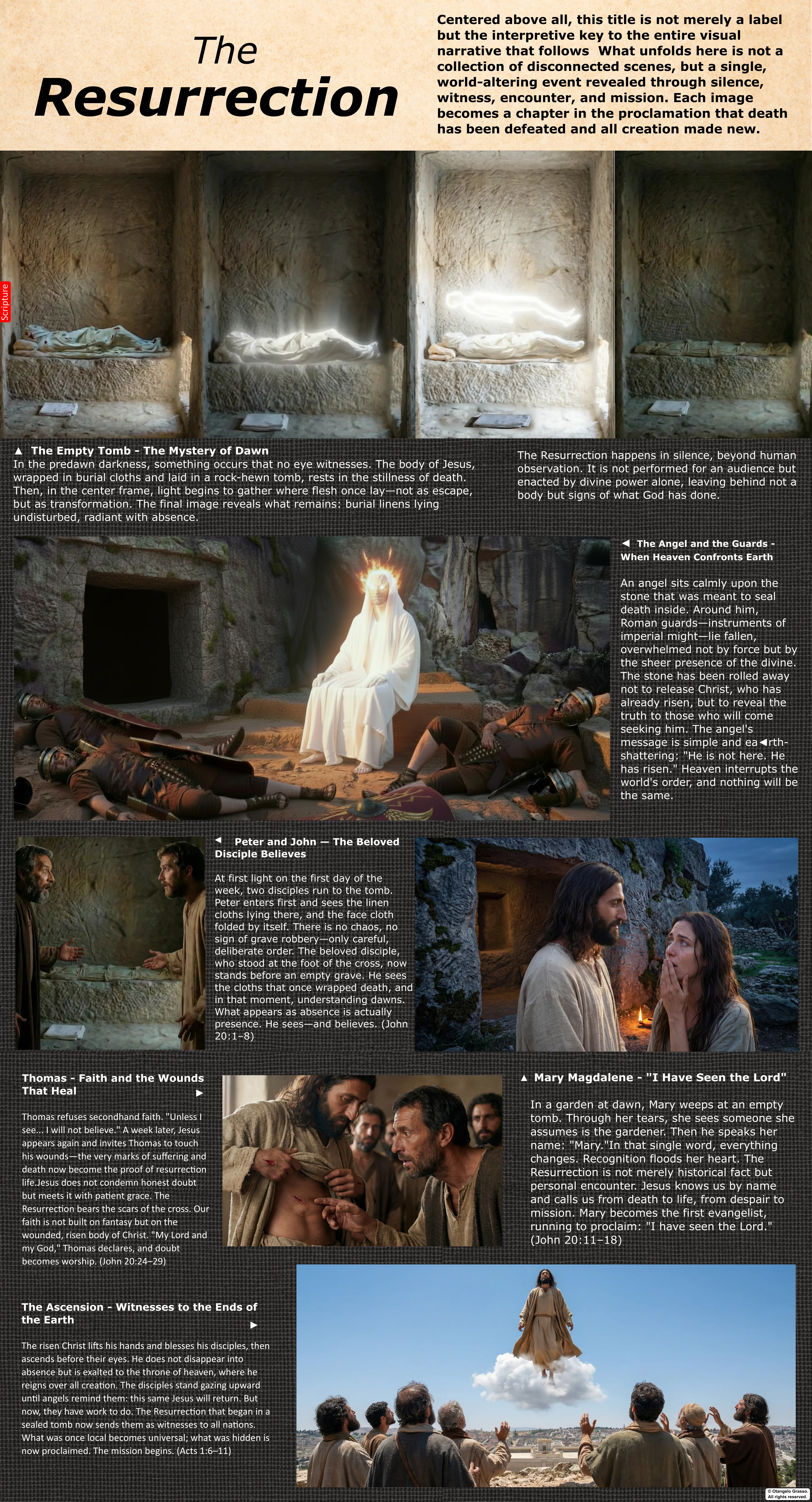
The cloths and the question
The burial linens occupy a small but consequential place in the Gospel accounts of Jesus' death and resurrection. They enter the narrative as the materials used to receive an executed body. They appear again when the tomb is found empty. In John, the linen cloths remain, the head cloth is distinguished from them, and the other disciple enters, sees, and believes. The reader is invited to consider the significance of what was left behind.1
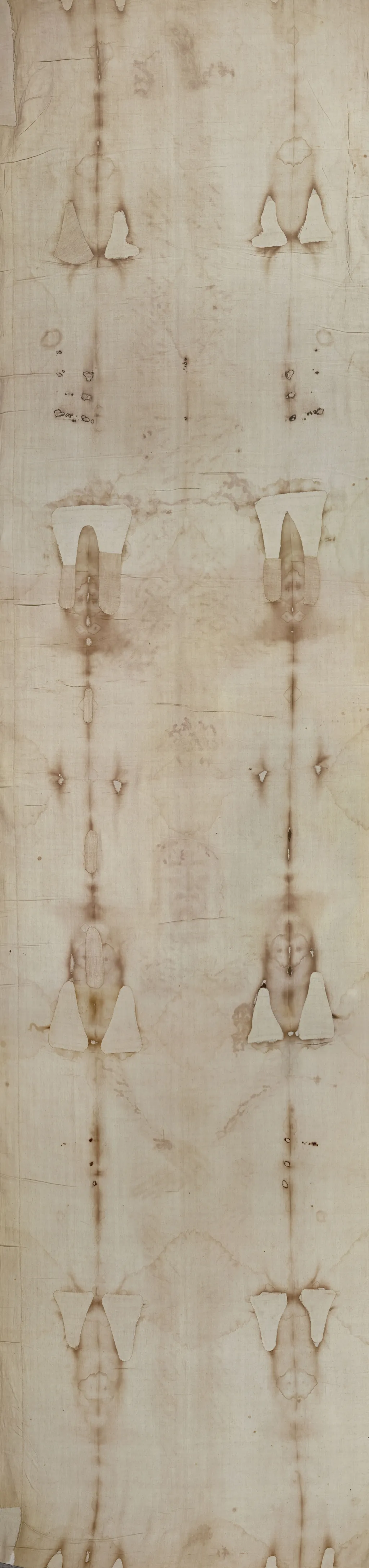
The Shroud of Turin brings a second kind of evidence into this discussion: an existing linen bearing a faint front-and-back human image and reddish wound-associated marks. Its proposed identification as Jesus' burial shroud creates a possible connection between the Gospel narrative and a material object. That connection must be examined rather than assumed. A reading of John 20 does not authenticate the Turin cloth, and a laboratory examination of the cloth does not recover a photograph of the tomb on Easter morning.2,3
The strongest case develops these two inquiries together while preserving their different evidentiary foundations. The textual inquiry asks what the evangelists actually describe. The historical inquiry asks how that description fits burial practices and the development of Christian testimony. The forensic inquiry asks what the cloth and its samples disclose about image formation, biological material, contact, and subsequent handling. Christian theology asks what the resurrection means. Each inquiry contributes something the others cannot supply by themselves.
This chapter argues that the empty wrappings are an important part of John's presentation of the resurrection, and that the Shroud's material properties justify a serious investigation of its proposed burial function. Neither the Greek vocabulary nor the surviving blood evidence, however, establishes an intact hollow shell, an exact thirty-six-hour contact period, or a scientifically measured passage of a body through linen. Those are additional interpretations requiring their own evidence. A Christian argument becomes more defensible when it states where the narrative ends and reconstruction begins.2,3,4,5
1 What John says was found
John 20 begins with Mary Magdalene coming to the tomb while it is still dark. She sees that the stone has been removed and reports that the Lord has been taken away. Her first interpretation is removal of the body. The narrative therefore introduces the empty tomb through uncertainty and grief rather than through an immediate assumption of resurrection.1
Peter and the other disciple run to the tomb. The other disciple arrives first and looks in. Peter enters and observes the linen cloths. John then distinguishes the cloth that had been on Jesus' head: it is separate from the other linens and described by a participle commonly translated as wrapped, rolled, or folded. The other disciple enters, sees, and believes. The narrator adds that they had not yet understood the scripture concerning Jesus' rising from the dead.1
Several elements are explicit. There had been a burial involving textiles. The body is absent when the disciples investigate. Linen cloths remain. A head cloth is mentioned separately. The other disciple's observation has a role in his coming to belief. These details are the foundation on which interpretation must be built.
Other familiar details are not explicit. John does not say that the linens formed a rigid shell. He does not state that every fold occupied its Friday position, that spices lay undisturbed inside the folds, or that the head cloth remained suspended where the head had been. He does not describe microscopic blood adhesion, fracture surfaces, or the absence of every sign of handling. The narrative is precise about selected objects without supplying a measured reconstruction of their geometry.1,2
This distinction changes the argument without emptying it of significance. Cloths left behind are relevant to the story. Their distinction from the missing body is part of the evangelist's presentation. An elaborate physical model of how they were left behind is an interpretation of that presentation. The first proposition can be defended from the text; the second must also answer linguistic, historical, and physical questions.
The words translated as seeing also deserve restraint. John uses different forms in describing looking into the tomb, Peter's observation, and the other disciple's seeing and believing. The progression creates a literary movement toward recognition. It should not be converted into a modern technical hierarchy in which one Greek verb denotes casual vision, another a forensic examination, and another an experimentally demonstrated conclusion. Narrative force and laboratory validation are different kinds of warrant.1
2 The vocabulary of the burial
The principal terms are sindōn, othonia, soudarion, and keiriai. They help distinguish a larger sheet, burial linens collectively, a head cloth, and bindings. They do not by themselves provide a complete inventory of everything present in the tomb.1,2
| Term | Meaning in context | What it does not establish |
|---|---|---|
| sindōn | Linen cloth or sheet used as the burial wrapping | The Turin cloth’s identity, dimensions, weave or date |
| othonia | Linen cloths or burial linens in the plural | Mandatory mummy bandaging or an intact empty shell |
| soudarion | Smaller cloth associated with the head | Its later identification with the Oviedo relic |
| keiriai | Bindings in the Lazarus account | The physical mechanism of Jesus’ departure |
| keimai forms | Lying or situated there | Untouched folds or collapse without any handling |
| entetyligmenon | Wrapped or rolled; commonly also translated folded | A unique geometry or the person who arranged it |
The larger sheet and the plural linens
Matthew, Mark, and Luke describe Joseph of Arimathea wrapping Jesus in a sindōn. The word can designate a linen cloth or sheet; its use is not restricted to funeral textiles. In these passages its burial function follows from what Joseph does with it. The description is compatible with a large sheet enveloping the body, such as the arrangement proposed for the Turin Shroud.1
John uses the plural othonia in the burial account and again in the empty tomb narrative. Translating the term as linen cloths preserves its breadth. It does not compel an Egyptian-style mummy made of narrow bandages, nor does it exclude additional bindings or smaller pieces used with a larger sheet. A single principal shroud and more than one linen item are linguistically compatible. Compatibility does not establish the dimensions or weave of any particular surviving cloth.1,2
The relationship between the Synoptic sindōn and John's othonia can therefore be understood as a difference in descriptive emphasis. The former names the principal wrapping; the latter refers to burial linens in the plural. That reading offers a coherent harmonization. It remains important to distinguish coherence from proof that each writer had an identical textile arrangement in view. The accounts do not offer an itemized list against which every proposed reconstruction can be checked.
The cloth that had been on the head
John's soudarion is a word associated with a smaller cloth. In John 20, its connection with the head is explicit; its precise earlier function is not. A face covering during removal and transport is one proposed function. A cloth securing the jaw is another. Its separation from the other linens on Sunday does not, by itself, establish when it was removed, who arranged it, or whether its Sunday position was unchanged from Friday.1,2,6
John's distinction creates a legitimate question about the use of more than one textile. It does not authorize a categorical statement that the soudarion was never part of the burial ensemble. A cloth can be distinguished from other items in the narrative while still belonging to the broader preparation of the deceased. Likewise, identifying a modern relic as that cloth requires more than showing that the Gospel mentions an object of the appropriate general kind.
Lying and wrapped or rolled
The forms of keimai in John 20 describe the linens as lying or being situated there. The verb does not itself mean collapsed without disturbance. In verse 7, the contrast concerns the head cloth's location relative to the other linens. The description of its wrapped or rolled condition has received more than one interpretation. Some readers understand a deliberately folded cloth; others a cloth retaining something of its earlier rolled configuration.1,6
Newman and Nida discuss both an arranged cloth and a retained wrapping shape in their translation commentary. Their discussion shows that the alternatives belong to interpretation of the phrase. It does not turn either into a recovered physical fact. The secure common ground is that John distinguishes the head cloth from the other linens and describes it as wrapped or rolled in a separate place.6
An argument that depends on the difference between a folded rectangle and an oval loop therefore requires more than an English translation. It requires a defensible reading of the Greek phrase, a plausible burial reconstruction, and a demonstration that competing readings do not fit. The familiar devotional story that a folded napkin was a Jewish signal meaning that the master would return is not supplied by John and should not be used as evidence here.
Lazarus and the contrast within John
John 11 describes Lazarus emerging bound with keiriai and with a cloth around his face. Jesus instructs others to release him. John 20 presents Jesus' burial linens without Jesus inside them. The contrast is meaningful within the Gospel: Lazarus returns to a life still subject to death, whereas Jesus' resurrection belongs to the Gospel's climactic presentation of his victory over death.1
That literary and theological contrast does not require a claim that different textile nouns demonstrate different physical laws. Lazarus needs to be unbound in the story; Jesus leaves linens behind. John does not explain the mechanics of Jesus' departure. The contrast can be affirmed fully without assigning a molecular process to either account.
3 Burial before the Sabbath
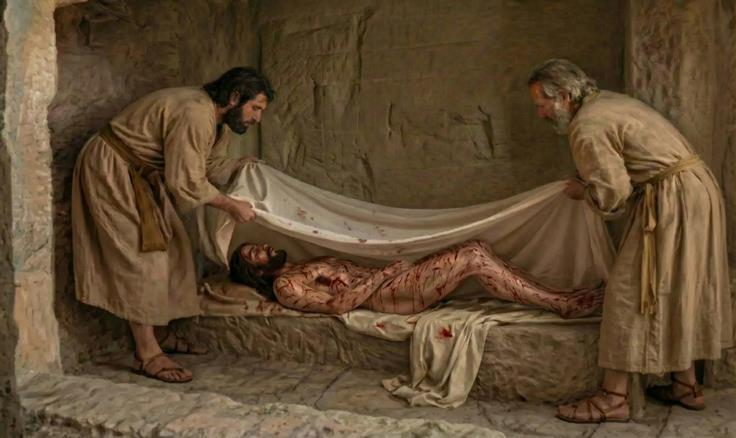
The burial accounts locate the preparation under time pressure before the Sabbath. Joseph obtains the body. The Synoptics mention the linen sheet, and John includes Nicodemus and an abundant quantity of myrrh and aloes. The burial takes place in a new tomb near the place of execution. The women's return in the Synoptic accounts gives the preparation a further narrative dimension.1
The quantity in John 19:39 is expressed as about a hundred litrai. Using a Roman pound of roughly a third of a kilogram gives an approximate modern equivalent of thirty-three kilograms. The estimate helps communicate scale. It should not imply a measured recipe, a known particle size, or a verified distribution of spices inside particular folds. John specifies the materials and abundance without describing their physical preparation in that detail.1,2
Jewish burial practices must be examined through texts and archaeological evidence rather than reconstructed from a single modern ritual handbook. Practices differed with time, place, means, and circumstances. Bodies could be wrapped in textiles, placed in rock-cut tombs, and later have their bones gathered in secondary burial. The precise treatment of an executed, injured body raises additional questions. Later prescriptions can inform comparison, but their application to first-century Jerusalem needs argument.7,8
The Akeldama burial studied by Matheson and colleagues is relevant because it supplies archaeological evidence of actual burial textiles in a first-century Jerusalem setting. It demonstrates that textile remains can enter this inquiry through excavation as well as literary description. It does not establish that every Jerusalem burial used the same fabric, nor does comparison with it date the Turin linen.8
The claim that Jesus' body was completely unwashed is contested even among writers favorable to authenticity. The presence of wound-associated marks does not settle it: partial washing, cleaning selected areas, fresh passive drainage, and remobilization of earlier blood can generate different transfer conditions. Conversely, the fact that John describes burial according to Jewish custom does not specify a complete washing sequence. The available narrative and material evidence underdetermine the procedure.3,9
For this chapter, the most defensible reconstruction is broad. A wounded body was received and prepared for burial in the Gospel narrative; linen and aromatic materials were involved; the Sabbath limited the available time. Whether the Turin cloth preserves that event is a further historical and scientific question. Describing the burial as hurried does not establish that its every stage was incomplete, and describing its materials does not prove that specific plant residues have been securely identified on the Shroud.
4 Three questions that must be answered separately
The authenticity debate often compresses three questions into one: How old is the cloth? Did it receive marks from a human body? Was that body Jesus? A fourth question concerns the cause of any subsequent separation. Evidence relevant to one question does not automatically answer the others.2,3,4,5
A textile can be old without having wrapped Jesus. A cloth can contain real blood without having received that blood during the burial portrayed in the Gospels. A body-related image can be produced from a person, a statue, a relief, or an intermediate process; the merits of those possibilities require comparison with the object's actual properties. An image that remains incompletely explained does not carry a calendar date within its unexplainedness.
The same distinction applies to the empty tomb. Establishing that an existing cloth is consistent with burial use would not demonstrate its position in a particular tomb. Establishing an ancient date would not identify the deceased. Establishing an association with Jesus would make the question of separation especially consequential, but would still not turn the image into a recording of the moment of resurrection unless a link between those events were independently established.
The proper sequence of reasoning is conditional. If the Shroud is the linen used in Jesus' burial, its properties become relevant to that burial. If the wound-associated material transferred directly from a body, contact mechanics become relevant. If a particular image process occurred while the body was present, cloth geometry becomes relevant. Each condition has an evidentiary burden. Writing the conditions explicitly prevents a proposed reconstruction from silently becoming its own proof.
5 The wound marks and the body image
The Shroud displays two visually distinguishable systems: the faint yellow-brown body image and reddish marks associated with wounds. The difference matters because their materials, optical behavior, and formation need not be the same. Any integrated explanation has to account for both systems and their spatial relationship.2,10,11,12,13
Heller and Adler's investigations reported heme-related reactions and other findings consistent with blood in sampled reddish areas. Their work provides a substantive basis for treating the wound marks as more than a merely red artistic appearance. The classical case rests on several complementary observations rather than on the presence of iron alone.10,11
The STURP synthesis described the body image as yellowed surface fibrils and found no added coloring substance sufficient to account for it. That finding distinguishes the team's explanation from a straightforward pigment-and-binder painting. It does not establish that every possible deliberate production process has been experimentally excluded. Composition and origin remain related but distinct questions.12,13
McCrone reached a competing interpretation emphasizing pigment particles. The disagreement concerns the identity, distribution, and explanatory importance of the recovered material, as well as what microscopic observations can establish about the whole image. Reporting this dispute does not require treating every interpretation as equally supported. It requires identifying the measurements each interpretation explains and the observations it leaves unresolved.14
Neither chemistry nor appearance alone supplies a complete chain of events. Detecting blood constituents does not identify the person. A finding about one tape-lift particle is not a complete characterization of all red material across the cloth. Contamination, devotional handling, repairs, fire, water, and contact with other objects complicate the history of a material that has never existed as a sealed modern forensic exhibit.3,4
Claims about species, sex, blood group, ancestry, and a terminal medical condition require separate validation. Kearse's recent assessment distinguishes the classical evidence for blood constituents from later, stronger claims made about them. In this chapter, the wound-associated material is not treated as a securely individualized blood sample from a named first-century man.4
The same restraint applies to bilirubin. Earlier authors connected its reported presence with severe trauma and with the reddish appearance of the stains. That interpretation should not be expanded into a measured premortem serum concentration or an exact diagnosis. A degraded residue is not a fresh clinical sample, and color has several possible determinants. A controlled analytical chain is necessary before clinical conclusions can be assigned to the deceased.3,4
6 Serum halos and the mechanics of transfer
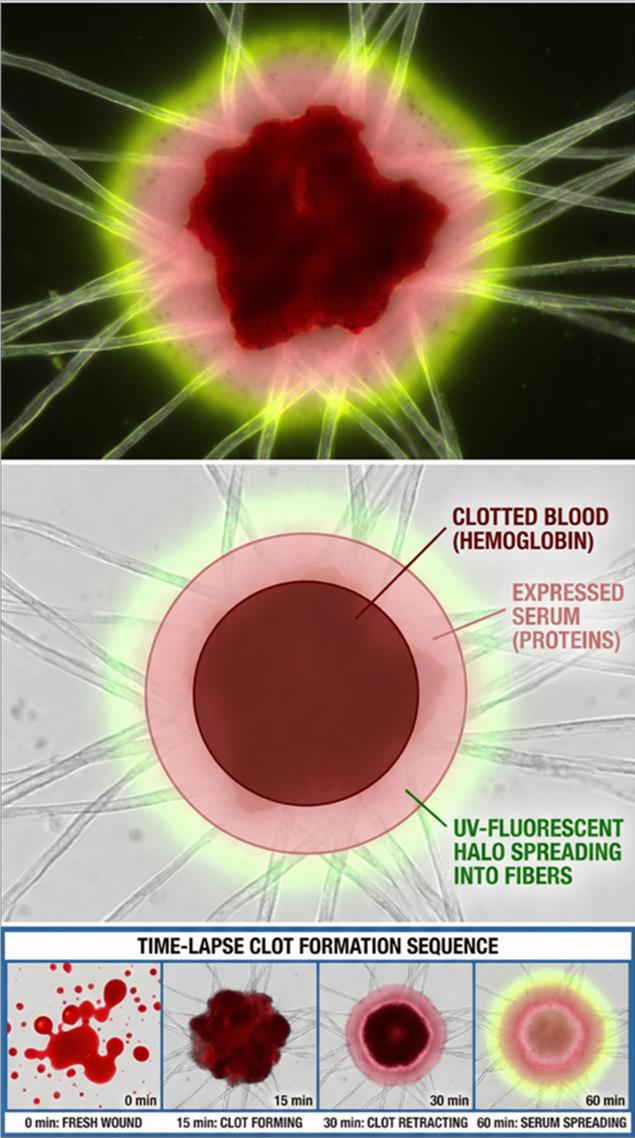
Ultraviolet fluorescence photography brought attention to pale margins around some wound-associated marks. These margins have often been interpreted as serum-rich regions surrounding more strongly colored blood material. They are important because visible-light appearance alone can miss fluid components that have migrated beyond a red stain.15
Whole blood contains cells suspended in plasma. During coagulation and clot retraction, a liquid fraction can separate from the clot. On absorbent material, different fractions can travel different distances. A relatively clear margin is therefore physically intelligible without any unusual cause. Its shape depends on fluid condition, surface properties, pressure, and drying conditions.3,16
Kearse's experiments showed that illumination near 365 nanometers can reveal plasma and serum that are difficult to see under ordinary illumination. Under tested conditions, transferred clot material and directly added blood could produce different peripheral patterns. The experiments demonstrate the usefulness of such observations; they do not make every fluorescent margin a uniquely diagnostic marker of one transfer pathway.16
The substrate is part of the experiment. Filter paper, untreated linen, finished linen, leather, and other surfaces differ in absorption and spreading. A result on one surface cannot simply be declared universal. The surface chemistry of historic flax, its finishing, accumulated contamination, and its thermal and water history also need to be represented in any attempt to reproduce Shroud-like margins.3,16
Kearse's humidity experiments provide another relevant result: under the tested high-humidity conditions, dried blood became transferable to absorbent material while retaining aspects of the earlier pattern. This is a natural mechanism worth considering in burial models. The experimental result does not tell us the temperature, humidity, or wetness at the surface of Jesus' body in the actual tomb.17,18
König and colleagues reproduced a pale peripheral pattern using sequential clear-fluid and blood applications. Their experiments also explored handling and washing scenarios for other marks. These are alternative mechanisms for selected features, not reproductions of the complete Shroud. Their relevance is that a particular feature should not be declared exclusive to one explanation when an experimentally demonstrated alternative produces something similar.9
Grasso's newer blood-transfer review brings these findings into a sequential model: earlier bleeding and clotting, fluid separation, partial drying, disturbance during removal and handling, passive drainage after death, and transfer while material remains moist or becomes transferable again. The model is valuable because it recognizes that different phases can occur at the same wound. Its complete sequence remains a proposal awaiting controlled reconstruction and comparison with alternatives.3
7 Why the stains do not supply an exact thirty-six-hour clock
A claim repeated in Shroud literature is that the blood marks fix the body's contact with the linen at approximately thirty to thirty-six hours. The attraction is understandable: the interval resembles a traditional reconstruction from Friday burial to early Sunday discovery. Resemblance between a proposed scientific interval and a narrative chronology is not, however, independent confirmation unless the interval was measured without importing the chronology.2,3
Fibrinolysis concerns breakdown of the fibrin network. It is affected by biological and environmental conditions, including what happened before death and the condition of the blood afterward. The condition of a bloodstain on historic linen adds further variables: drying, rehydration, heat, fluid migration, age-related chemical change, and the type of material actually sampled.3
To turn these processes into a clock, investigators would need authenticated markers whose initial states were understood, experiments spanning relevant conditions, a quantitative relationship between measurement and time, and error estimates. They would also need to show that the centuries after deposition had not erased or mimicked the chosen markers. An exact schedule cannot be obtained merely by assigning successive stages of clot softening to blocks of twelve hours.
The material reviewed here does not provide a validated calibration that converts a measured Shroud fibrin state into thirty-six hours of body contact. The classic blood-identification papers should not be cited as though they established such a calibration. The newer blood-transfer review expressly treats timing and environmental reconstructions as underdetermined.3,10,11
The distinction between deposition time and separation time is equally important. A stain can transfer early and remain on linen long after the body is removed. Later rehydration can alter transferability without restaging the deceased's original physiology. A wound can have several deposits from different moments. Dating one component would not automatically date the final removal of the body.
The Friday-to-Sunday framework belongs to the Gospel chronology. The Shroud can be assessed for compatibility with a short burial. It should not be presented as an independent stopwatch for the resurrection. This correction preserves the meaningful comparison while removing a circular argument.
8 The separation problem
If the Shroud received wound marks through contact with a body, the eventual separation of body and cloth is a legitimate forensic question. Some deposits appear well bounded, and proponents have argued that extensive peeling or dragging would have disturbed them. The observation deserves experimental investigation. Its significance depends on the condition of the deposits and on what separation would actually do to them.2,3
Two different interfaces must be distinguished. One is the bond between material and linen. The other is the earlier connection between the deposited material and skin, hair, or a wound. A sample removed from linen centuries later does not preserve both interfaces automatically. Showing that blood is attached to fibers is not equivalent to showing how the cloth detached from the body.
The proposition that every ordinary removal must leave unmistakable tearing is too broad. Adhesion changes with drying, wetness, clot condition, surface chemistry, pressure, and the angle and speed of removal. Some deposit can remain on the cloth while separation occurs elsewhere. A body can also be lifted from underneath while an overlying sheet is opened, or the cloth can be supported in ways that alter shear. Whether a particular sequence preserves the observed pattern is an experimental question.3
The opposite assertion—that neat stains require no explanation—is also unsatisfactory. A viable ordinary-removal model must reproduce the relevant morphology, textile penetration, and spatial coherence under realistic conditions. A careless demonstration that leaves a vaguely similar red mark is not enough. The correct comparison is between defined mechanisms judged against the same measurable target.
At present there is no demonstrated whole-cloth map of separation damage with a validated detection threshold that excludes all ordinary removal. The published case is largely an interpretation of selected stain features and the apparent absence of gross disturbance. It supports a question about separation; it does not establish force-free separation as a measured historical event.2,3
The phrase nonmechanical separation should therefore be used as the name of a proposed explanation. It should not stand in for the observation itself. A result showing that several tested removal methods fail would exclude those methods under those conditions. A stronger universal claim requires a broader evidentiary foundation.
9 Decomposition and the limits of negative evidence
The Shroud is not generally described as displaying an obvious extensive pattern of putrefactive leakage. Under a body-contact interpretation, that is consistent with a limited period of contact or with conditions that did not produce such a pattern. It does not establish that no decomposition had begun. Biological changes begin before the later stages that produce conspicuous leakage.2,3
The visible result depends on temperature, humidity, body condition, microbial activity, trauma, enclosure, and duration. It also depends on whether resulting material reached the cloth, survived, and can still be identified. A universal assertion that a Mediterranean corpse must saturate its wrapping within a fixed forty-to-seventy-two-hour interval does not account for those variables.
There is a difference between not observing a stain and showing that a stain should have been present and detectable under every relevant alternative. The latter requires experiments or a validated comparative dataset. The same principle governs the apparent absence of smearing: an absence becomes discriminating only after its expected occurrence and detectability are established.
The defensible conclusion is limited but useful. No obvious extensive putrefactive staining has been established as a defining feature of the body image. That observation can enter a comparison of burial scenarios. It cannot identify an exact contact duration, establish that the body's tissues never decayed, or determine why the cloth ceased to enclose a body.
10 Cloth geometry and the image
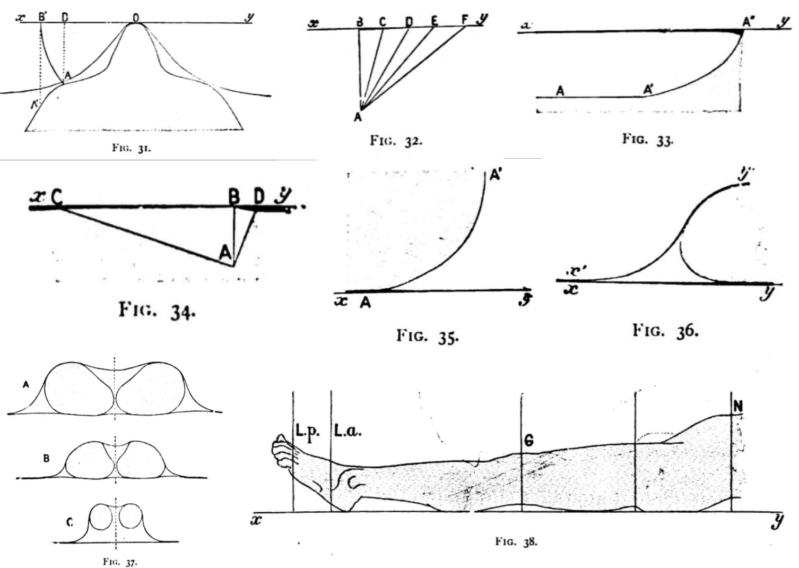
The Turin image presents a geometrical problem as well as a chemical one. A flat textile can contact some parts of a three-dimensional body while bridging others. A sheet wrapped tightly around the sides records surface positions differently from a sheet draped more loosely across the front. Unfolding either sheet changes how the resulting two-dimensional pattern appears.2,5
Vignon's historical sketches explored such relationships through body cross-sections and cloth position. Their importance is conceptual: they ask what a cloth could contact and where distance would intervene. The drawings are not measurements of the original burial arrangement, and their usefulness does not depend on accepting Vignon's proposed image chemistry.5
Jackson, Jumper, and Ercoline tested a relationship between image shading and distance from a body form to a naturally draped cloth. Their 1984 paper reported that a global mapping of the gap could account for the frontal shading in the tested reconstruction. It also identified difficulties facing several candidate mechanisms. This is an important geometrical result within an explicit model, rather than a direct observation of how the historical image formed.19
The distinction is crucial when discussing vertical mapping. A mapping rule can describe how positions or intensities correspond under a proposed geometry. It does not, without further physical evidence, identify a vertical ray, a burst of light, or a body moving through the cloth. Mathematical consistency with one model is not a recovered film of the event.
Grasso's draping paper proposes a two-stage reconstruction: contact transfer of blood, followed by image formation under a gently draped configuration. It also explores unloading or elevation to address dorsal-image questions. Those proposals organize testable questions, but their status is different from a published measured result. The paper's proposed simulation protocol should not be described as a completed, independently replicated computational reconstruction.5
The distinction between a proposal and its execution is especially important for claims of agreement among independent methods. A suggested parameter range, an assumed transfer law, or a proposed optimization criterion is not new experimental evidence. Several papers that adopt the same earlier image data and assumptions do not automatically become independent confirmations of those assumptions.
Front and back require joint treatment. The lower cloth could have been load bearing, while the upper cloth draped across gaps. Contact pressure, deformation, supports, pose, and different image-transfer conditions all affect a full reconstruction. Similar apparent intensity on two sides is a question for measurement; it does not on its own demonstrate levitation or transient weightlessness.
11 What three-dimensional rendering establishes
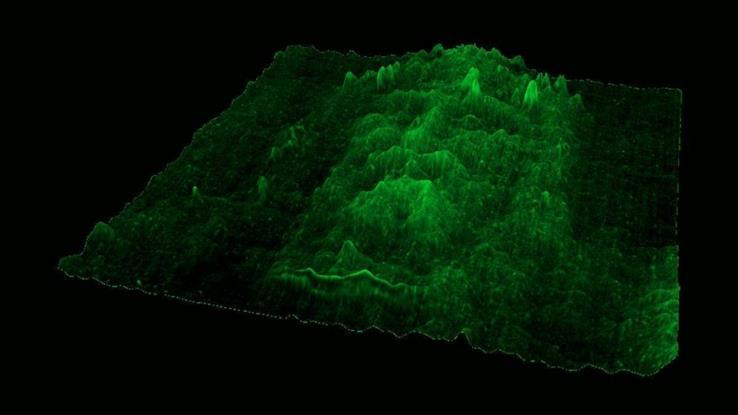
A VP-8 analyzer and modern height-mapping software assign apparent height to brightness. The resulting relief is a visualization of the input under a selected transformation. In a favorable image, it can resemble an anatomically intelligible form. In an ordinary photograph, lighting and surface reflectance can make the relief look distorted.19
The Shroud's response to such processing is relevant because it motivates a relationship between tonal structure and form. It does not mean that no artificial image can produce a recognizable relief. An image constructed with a suitable brightness gradient can do so. The scientific issue is whether one process can jointly explain the actual tonal structure, chemistry, resolution, drape distortions, and relationship with the wound marks.5,19,20
Nor does a more detailed rendering independently validate the data from which it was made. If several visualizations use the same photograph, they are transformations of shared evidence. Enhancement can clarify a feature, but can also strengthen noise, emphasize photographic artifacts, or introduce assumptions about smoothing and depth. A visually convincing face is not, by itself, a new anatomical measurement.
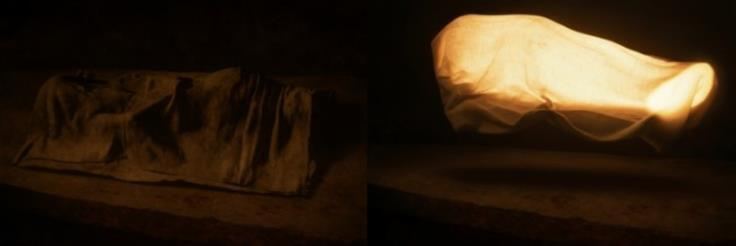
For the empty-wrappings question, image formation and final cloth position must be separated. A draped cloth can receive an image before it is later removed, folded, or collapsed. Demonstrating an image-compatible drape would concern the first event. It would not determine the second unless the mechanism independently required collapse during image formation.
Consequently, the three-dimensional argument cannot by itself establish that John's linens were undisturbed, that the Turin cloth was among them, or that the image formed when a body ceased to support the cloth. Those propositions can be brought together in a hypothesis. They should not be counted as three independent measurements of the same event.
12 Proposed image mechanisms and the resurrection
Several classes of image mechanism recur in the literature: direct or indirect artistic application, contact and relief processes, chemical reactions involving linen and organic material, thermal processes, ultraviolet coloration, electrical discharge, and particle or radiation proposals. Each must be assessed against the properties actually established for the cloth.5,20
Di Lazzaro and colleagues demonstrated ultraviolet coloration of linen under controlled irradiation. Such experiments are relevant to the chemical feasibility of producing superficial discoloration. They do not show that an ancient body emitted laser-like radiation, reproduce every property of the complete double image, or identify the resurrection as the cause of the Turin coloration.21
Jackson's fall-through proposal explicitly explored a process beyond established ordinary mechanisms. It connects a hypothesized altered interaction between body and cloth with formation during cloth collapse. Its theological interest is evident. Its scientific assessment depends on specifying testable consequences that distinguish it from competing mechanisms, rather than treating its agreement with a resurrection interpretation as experimental confirmation.22
A resurrection-radiation hypothesis also needs to distinguish three things: the Christian claim that Jesus rose bodily, a proposed physical accompaniment of that event, and the claim that the accompaniment produced this particular image. None follows automatically from the others. Christianity does not require that every resurrection leave an image on linen. Likewise, a linen-coloration experiment does not supply a theory of a glorified body.
The unresolved state of complete image formation is a reason to investigate. It is not a numerical probability of miracle. Nor does accepting a medieval date identify a specific workshop procedure. An explanation has to earn its support by accounting for the object and its history. Both authenticity and manufacture arguments lose force when an incomplete competing account is treated as proof of their preferred conclusion.20
13 The separate cloth and the Sudarium of Oviedo
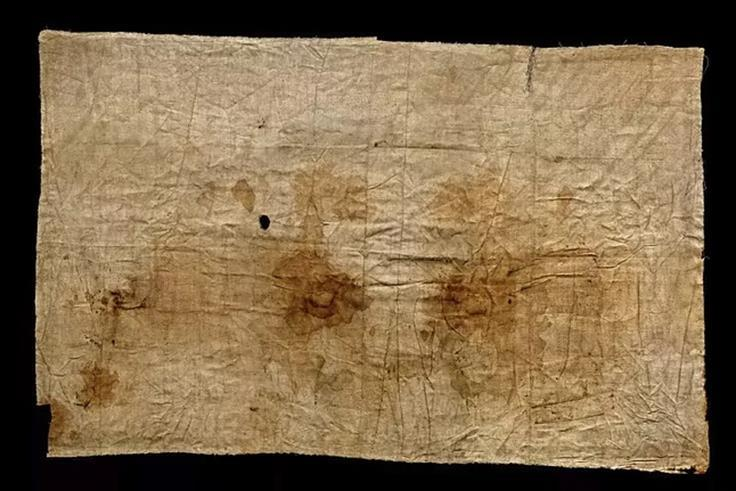
The Sudarium of Oviedo is a smaller stained linen traditionally associated with Jesus' head. Unlike the Turin Shroud, it does not display a comparable full-body image. Its proposed function fits the general category of a smaller cloth used around the face or head. John supplies a reason to ask about such an object; he does not supply its later Spanish provenance.1,23
Guscin and the Spanish research team describe a sequence of application and handling intended to account for the Sudarium's stains. Heras and colleagues compare its proposed geometry with the Turin cloth. Their reports are relevant primary presentations of the comparative argument, but the historical reconstruction and same-person attribution are conclusions to be assessed, not starting facts.23,24
Grasso's catalogue lists forty-nine reported correspondence claims across anatomical, fluid, spatial, textile, and chemical categories. The catalogue makes clear what different authors have asserted. Forty-nine listed claims are not forty-nine independent forensic identifications. Several concern the same proposed feature or depend on a shared image registration.25
Point counts require particular care. Before a correspondence can carry a probability, investigators must specify what qualifies as a match, how cloth deformation is handled, what rotations and scaling are allowed, how landmarks are selected, and how often unrelated comparison patterns produce similar results. A threshold borrowed from another identification discipline cannot be imported without validation.
The claimed matching AB blood groups are also insufficient for individual identification. Even valid agreement on a common blood group would be a class characteristic. With degraded historic material, antibody specificity, environmental residues, contamination, and controls become additional issues. Kearse's assessment of AB claims explains why stronger popular statements exceed the analytical foundation.4,26
The cloths' distinct custodial histories are relevant to arguments about coordination. They do not make coordinated production, copying, later contact, or chance resemblance logically impossible. A demonstrably early history for one relic does not automatically establish an equally early history for another. Historical independence and statistical independence are different propositions.
The strongest way forward is a blinded comparison using original calibrated images, prespecified landmarks, physically constrained deformation, suitable unrelated controls, and publication of successful and unsuccessful registrations. Such a study could measure the value of the proposed correspondences. Until then, they remain an interesting supplementary argument rather than a conclusive link between two objects and one individual.25
14 The dating question remains central
The identification of the Shroud with the linens in John 20 depends on antiquity. The 1988 radiocarbon investigation, published in 1989, reported a calibrated medieval range of 1260–1390 CE at at least 95 percent confidence for the sampled material. This is substantial direct dating evidence. An account of the Shroud as a first-century burial cloth has to address it explicitly.27
Rogers subsequently argued that the radiocarbon sample region differed chemically from the main cloth and questioned its representativeness. That argument is relevant to sampling. It should not be recast as a universally accepted demonstration of a first-century date. A challenge to the representativeness of a sample and a successful independent dating of the whole textile are distinct achievements.28
Grasso's newer textile and radiocarbon reviews discuss the force of the medieval result alongside sampling, repair, contamination, and other proposed explanations. They also acknowledge difficulties facing strong repair and contamination arguments. Their treatment is more useful when it tests proposed mechanisms quantitatively than when it treats any unresolved irregularity as sufficient to remove the radiocarbon result.29,30
Ordinary contamination has a mass-balance burden. A proposed contaminant must possess the relevant radiocarbon content, occur in enough quantity, survive pretreatment, and account for the measured result. Merely naming smoke, microbes, handling, or water does not satisfy those conditions. The percentage needed depends on the age and composition assumed for both cloth and contaminant; a numerical claim must state those assumptions.
The 2026 examination of retained radiocarbon fragments by Freer-Waters and Jull found the two analyzed fragments consistent with the main Shroud and reported no evidence of contamination. This result weighs against claims that those fragments are obviously anomalous material. It remains an examination of two fragments, rather than a geographically distributed redating of the entire Shroud; extrapolation must remain tied to what was examined.31
Textile construction does not resolve the question by itself. A herringbone weave, yarn twist, seam, or fiber characteristic can be historically informative without functioning as a unique first-century timestamp. A proposed comparison with an ancient textile requires assessment of how widely the feature occurs across places and periods. The same applies to pollen and limestone: a plausible association is different from a unique provenance marker.29
The direct dating result and the unusual image properties need to be addressed together. Difficulty explaining an image does not nullify a date; a date does not explain image chemistry. Maintaining both questions allows research to proceed without forcing an incomplete answer in one field to settle the other.
15 Testing explanations of the empty tomb
The empty-tomb narratives are historical testimony preserved in literary form. They are not a modern scene record with photographs, sealed samples, and a documented evidence log. Proponents and critics should state which narrative details they accept before using them to test explanations. A hypothesis cannot be refuted by details that have first been added to the account as an unverified reconstruction.
| Proposal | Question it must address | Limit on the comparison |
|---|---|---|
| Removal by followers | Body absence, remaining cloths, motive and later testimony | Neatness alone does not make removal physically impossible |
| Removal by others | Evidence for agency, motive, and subsequent fate of the body | Lack of a recorded rebuttal is not a complete investigation log |
| Mistaken location | Known burial location and why a mistake persisted | Other tombs need not have only two possible contents |
| Experiential explanation | Origin and character of reported appearances | Does not by itself explain a separately accepted empty tomb |
| Narrative development | Transmission, genre, chronology and concrete details | Literary detail can occur in both memory and composition |
| Bodily resurrection | Historical support for burial, absence and appearances | A further radiation mechanism is a separate claim |
Removal by followers
If the burial linens were left in the tomb as John describes, a removal theory has to explain why a body would be transported without the same wrappings or why the wrappings would be returned. That is a legitimate practical question. It does not establish physical impossibility. A theorist could propose additional cloths, a change of wrapping, a temporary relocation, or deliberate arrangement. Those additions carry historical costs and need evidence.
The disciples' fear in John and the later willingness of some Christian witnesses to suffer are relevant to assessments of sincerity. They do not independently establish the exact state of the tomb. Sincere belief does not identify its cause, and generalized claims that every apostle had a documented opportunity to avoid death by retracting a known fraud require more evidence than is usually provided.1,2
The Christian case can question the motive, practicality, and evidentiary support for deliberate deception without using the absolute statement that no person ever dies for a falsehood they helped construct. The narrower argument is stronger: the records present a movement proclaiming encounters with a risen Jesus, and a theft hypothesis must explain the origin and persistence of that proclamation as well as the empty-tomb tradition.
Removal by authorities or others
Removal by authorities raises questions of motive and later access to the body. If identifiable remains were available, their production could have challenged resurrection preaching. But an argument from nonproduction must distinguish the absence of a recorded successful rebuttal from proof that every authority searched, possessed the relevant information, or could identify remains at the relevant time.
Removal by unrelated persons is even less specified. Naming an unspecified remover does not supply an explanatory history. At the same time, a lack of evidence for such a remover is not a laboratory exclusion of all human agency. The comparison must concern actual explanatory support rather than mutually inflated claims of certainty.
Mistaken location
A wrong-tomb theory must account for the named burial figure, the women's reported knowledge of the place, the disciples' visit, and the subsequent tradition. The presence of burial linens is an additional detail if John's account is accepted. The theory therefore has explanatory work to do.
It is unnecessary to claim that any other tomb would necessarily contain a complete corpse or old skeleton. Other possible states exist. The more defensible objection is that a mistaken-location scenario needs evidence and must explain why the mistake was not corrected within the circumstances described. Its difficulty is historical and cumulative, not a logical impossibility based on a false exhaustive list of tomb contents.
Experiences without a bodily resurrection
Visions, grief-related experiences, and other proposed explanations of reported appearances address the experiences of witnesses. By themselves they do not remove a body. A complete account of Christian origins that accepts an empty tomb must therefore connect an explanation of experiences with an explanation of the body's absence. A critic who rejects the historicity of the empty-tomb account has a different burden: explaining the emergence and literary role of that tradition.
The alternatives should not be compressed into a simplistic claim that hallucinations either explain everything or explain nothing. Different hypotheses explain different portions of the evidence. The Christian resurrection claim is evaluated against their combined explanatory reach, with the reliability of the underlying sources remaining central.
Narrative development
Concrete details can reflect memory. They can also occur in carefully composed narrative. There is no general law that legends become less detailed over time or that mundane detail proves eyewitness authorship. John's close attention to the head cloth and the disciples' actions deserves historical analysis; it does not settle authorship or historicity without that analysis.
An account of narrative development must nevertheless explain why these particular details appear and how they relate to earlier burial and resurrection traditions. Dismissing them as literary is not a complete explanation, just as calling them forensic is not a complete authentication. Historical argument requires comparison, dating, genre, transmission, and attention to both agreement and variation.
16 How a cumulative argument should be built
The case for an authentic Shroud is cumulative. Its proponents bring together textile study, image properties, wound patterns, chemistry, historical sources, and comparison with the Sudarium. This breadth is relevant, but the number of listed observations is not the same as the number of independent evidentiary lines.20,25,29
For example, several descriptions of superficial coloration can derive from one microscopy dataset. Numerous blood claims can rely on a small set of tape samples. Several three-dimensional renderings can come from one photograph. Correspondence with the Gospel can be partly shaped by choosing the Gospel as the guide for interpreting ambiguous marks. None of those observations is worthless; they need to be grouped according to shared dependence.
Grasso's revised image-requirements paper explicitly reduces inflated lists by organizing related characteristics into broader constraint families. That is an important improvement. Repeating one underlying property under several names can make a case look numerically stronger without adding evidence. A complete mechanism is challenged by the conjunction of independent properties, not by the length of a checklist.20
The same discipline applies to numerical odds. If events or observations are dependent, multiplying their estimated probabilities produces an unreliable result. Assigning small numbers by intuition does not become a statistical demonstration when the numbers are multiplied. A defensible comparison requires explicit hypotheses, data, error rates, selection effects, and a treatment of dependence.
There is also a distinction between what a maker intended and what a process happened to produce. A medieval maker would not have to understand every microscopic byproduct of a technique for that byproduct to occur. A manufacture hypothesis still has to reproduce the properties, but the relevant burden is physical and historical feasibility rather than proof of a maker's knowledge of modern terminology.20
The cumulative argument is strongest when favorable observations, contrary evidence, and unresolved methodological questions appear together. The medieval radiocarbon result belongs in that argument. So do the unusual properties identified by STURP. Neither should be concealed in an appendix while the other is allowed to determine the verdict in advance.
17 Resurrection as a Christian historical and theological conclusion
Christianity's central claim is that Jesus, who was crucified and buried, was raised bodily and appeared to witnesses. The claim does not depend on the modern authenticity of a particular relic. In 1 Corinthians 15, Paul places death, burial, resurrection, and appearances together in a proclamation that predates modern Shroud research.1
John's empty linens function within that larger claim. Their abandonment contrasts with a burial that has achieved its ordinary purpose. The wounds shown to the disciples connect the risen Jesus with the crucified Jesus. The narrative presents continuity of identity and a transformed condition of life. The text's theological force does not require a speculative description of progressive dematerialization.
The appearances in rooms with closed doors are also not a laboratory account of passage through solid matter. John narrates Jesus' presence under those circumstances. He does not state a mechanism involving altered particle interactions, optical radiation, or the conversion of body mass into energy. Attaching any of those processes to the resurrection creates an additional physical claim.
For a Christian reader, the Shroud can have devotional and apologetic value while those additional claims remain unestablished. If authentic, it would be a remarkable material association with the Passion. Its wounds and abandoned burial function would acquire meaning within the Gospel narrative. The conclusion that God raised Jesus would still belong to an assessment of historical testimony and theological explanation, rather than to a single optical or hematological measurement.
For a reader who doubts authenticity, the separation of claims is equally helpful. A medieval cloth would not by itself refute the resurrection. A failed image mechanism would not authenticate the relic. A corrected blood claim would not dissolve every other finding. Each conclusion has to be tied to the evidence capable of supporting it.
The question is therefore larger than whether science can prove a miracle. Historical events are assessed from testimony, context, and surviving traces; scientific work constrains particular material claims. Theology addresses the identity and action of God. The disciplines can inform a shared inquiry without being treated as interchangeable sources of certainty.
18 Research that could discriminate between the proposals
The most useful next studies would target the claims on which competing explanations diverge. General appeals for more research are less useful than specifying the observable result, competing predictions, and conditions under which a favored explanation would be revised.3,5,20,25
Reconstructing transfer and separation
A study of blood transfer should compare natural clot transfer, moist whole-blood contact, rehydrated deposits, washing-related remobilization, and deliberate application of blood and clear fluids. The linen should be characterized for weave, finish, absorbency, and prior treatment. Investigators should record temperature and humidity at the actual skin-or-analogue interface, rather than treating room humidity as a complete description of local conditions.
The separation phase must be measured rather than assumed. Deposits should be detached at defined wetness states, angles, speeds, and loads. Their visible appearance, ultraviolet margins, microscopic structure, and penetration should be recorded before and after separation. Analysts unaware of the production method should then compare the results against prespecified features. Such experiments would test whether the features used to argue for undisturbed separation actually discriminate among mechanisms.3
Heat and water history require controls. A margin that appears after a modern transfer may not retain its form after centuries, and a later wetting event can redistribute material. Testing plausible classes of alteration is necessary before a modern analogue is treated as a historical reconstruction. No experiment should be credited with reproducing the complete Shroud merely because it reproduces one stain class.
Mapping composition and spatial sequence
Noncontact calibrated imaging should precede any new sampling. Visible reflectance, ultraviolet fluorescence, and complementary spectroscopy should be registered to the same cloth coordinates. This would allow analysts to ask whether a particular pale edge is chemically distinct, whether red material has more than one component, and how damage boundaries relate to proposed biological features.3
If sampling is permitted, authenticated provenance, extraction blanks, nearby linen controls, and independent replication are essential. Modern molecular work should distinguish detection of generic biological material from species assignment and individual identification. Findings from one thread should remain tied to that thread until a wider spatial distribution is demonstrated.
The often-repeated blood-before-image interpretation deserves a comparable registered study. Reports that material removed from under selected blood deposits lacks body-image discoloration are relevant to chronology. A modern investigation should document location, optical conditions, residue removal, and controls, then test competing explanations. Even a secure sequence would constrain image formation without, by itself, identifying the person or proving how the body was removed.2,12,13
Testing drape and image formation
A geometrical study should publish the body form, cloth model, mechanical properties, boundary conditions, photographs, and fitting procedure. Parameters should be estimated on one portion of the image and tested on another. A model whose assumptions are chosen after viewing every result risks reproducing its own fitting choices. Successful predictions outside the fitted regions would carry more weight.5
Candidate image processes should be compared on the same target properties. Chemical similarity on a tiny swatch, an attractive full-size silhouette, and a recognizable brightness relief are different achievements. They should not be assembled from separate specimens into an imaginary successful replication. Conversely, failure under one parameter set should not be described as proof that an entire physical class is impossible.20
Testing chronology and the two-cloth comparison
Further dating would be most informative if geographically distributed samples were authorized and the sampling design, pretreatment, images, and measurements were published. Such a program could address representativeness more directly than repeated interpretation of one corner. It would also have to respect the conservation constraints of the object.27,28,29,30,31
The Shroud-Sudarium comparison should use original image data and a locked registration protocol. Analysts should report uncertainty in stain boundaries and deformation rather than present a single favored overlay as a final identification. Negative controls and unrelated stains are necessary to estimate how readily the proposed matching procedure produces apparently compelling correspondences.25
19 The evidentiary balance
The strongest statement about the tomb is textual: John describes burial linens remaining after the body is absent and distinguishes the head cloth from the other linen. The strongest statement about the Turin object is material: it bears a distinctive faint double image and wound-associated marks that have generated serious chemical, optical, textile, and forensic investigation.1,2,10,11,12,13,14,15,16,17,18,19
The connection between those statements is a hypothesis of historical identity. It is supported by arguments about congruence with the Passion and challenged by the medieval radiocarbon result and gaps in provenance. It cannot be settled by translating a common verb as though it meant a physically undisturbed collapse, or by assigning exact hours to a blood process that has not been calibrated on the object.3,27,28,29,30
Several claims remain worth investigating: biological transfer, the relationship between blood and body-image coloration, the draping geometry, the full image mechanism, and the reported Sudarium correspondences. Their interest is not diminished by recognizing that they have different levels of directness and validation. A good investigation identifies what new observation would strengthen or weaken each one.
| Claim | Status in this chapter |
|---|---|
| John describes remaining linens and a separate head cloth | Explicit textual content |
| The linens retained an untouched body-shaped shell | Interpretive reconstruction |
| Blood-related constituents were reported in reddish samples | Published analytical finding tied to specific samples |
| The blood proves male, AB, Semitic identity | Not established by the validated evidence reviewed |
| The cloth contacted a body for exactly thirty-six hours | No validated object-specific clock demonstrated |
| No ordinary separation could preserve the marks | Universal exclusion not demonstrated |
| Shading can be compared with draped-body geometry | Published model-based result |
| Brightness relief proves resurrection-related collapse | Does not follow from height mapping alone |
| Two cloths contacted the same individual | Reported comparative hypothesis needing independent validation |
| The sampled textile gave a medieval radiocarbon date | Direct published dating result |
| Christian resurrection faith depends on the Shroud | Not a requirement of the biblical proclamation |
Conclusion The significance of what remained
The empty wrappings matter because John makes them part of the passage from loss to belief. They belong to a narrative in which the crucified Jesus is absent from the place of burial and subsequently encountered alive. The text invites historical attention to its concrete details and theological attention to the event it proclaims.1
The Turin Shroud, if it is the cloth used in that burial, would stand in a remarkable relationship to those details. Its proposed contact with an injured body, the separate behavior of wound marks and body image, and the geometry of its double image would bear directly on the handling of the deceased and the cloth's subsequent abandonment. The conditional identification remains the point that must be established, not a premise that scientific terminology can supply.
The evidence does not justify presenting a thirty-six-hour biochemical clock, a universally excluded ordinary separation, or radiation from a resurrecting body as established forensic findings. It does justify careful investigation of the object and serious comparison with the burial accounts. Christian interpretation can state its conclusion openly while allowing each scientific claim to stand or fall by the evidence appropriate to it.
References and descriptive source notes
- Biblical texts. John 11:44; 19:38–42; 20:1–29; Matthew 27:57–61; 28:1–15; Mark 15:42–47; 16:1–8; Luke 23:50–56; 24:1–12; 1 Corinthians 15:3–8. Greek text comparison: SBL Greek New Testament, John 20. Source link.Primary textual basis for the burial, remaining linens, appearances, and resurrection proclamation. Passage summaries distinguish explicit statements from reconstruction.
- Grasso, O. (2026). The Shroud of Turin: A Forensic Summary of the Evidence. Supplied third-edition PDF, 410 pages; especially chapters 3, 6, 14 and 15, with Chapter 15 on printed pages 262–274. Source link.Author’s book supplying the existing chapter, comparative argument, and figure provenance; a synthesis rather than a new primary laboratory investigation.
- Grasso, O. (2026). Blood Transfer, Serum Halos, and Postmortem Flow on the Shroud of Turin: A Critical Forensic and Hematological Narrative Review. Supplied Word manuscript. Source link.Principal supplied review for the sequential transfer model, humidity, clotting, alternative mechanisms, and limits of timing and identification claims.
- Kearse, K. P. (2025). The aggrandizement of scientific data in the media: The Shroud of Turin blood marks as a case example. Forensic Science International: Reports, 12, 100430. Source link.Critical assessment separating blood-component findings from stronger claims about species, sex, AB typing, ancestry, trauma, and premortem or postmortem classification.
- Grasso, O. (2025). The Draping Configuration of the Shroud of Turin During Image Formation: A Synthesis of Geometric, Photochemical, and Radiation Hypotheses. Supplied PDF, 14 pages, dated 18 September 2025. Source link.Supplied hypothesis paper proposing contact and imaging phases, drape constraints, and a simulation protocol; proposed work is distinguished from completed validation.
- Newman, B. M., and Nida, E. A. (1980). A Handbook on the Gospel of John. United Bible Societies. Commentary on John 20:7, reproduced by the UBS translation resource. Source link.Explains alternative interpretations of the separate wrapped or rolled head cloth. The web excerpt was consulted; the entire handbook was not read.
- McCane, B. R. (2003). Roll Back the Stone: Death and Burial in the World of Jesus. Trinity Press International. Source link.Contextual study of burial practices. Bibliographic and publisher information was checked; this volume was not available for a complete direct reading.
- Matheson, C. D., et al. (2009). Molecular Exploration of the First-Century Tomb of the Shroud in Akeldama, Jerusalem. PLOS ONE, 4(12), e8319. Source link.Primary archaeological investigation documenting burial textiles and associated remains from a first-century Jerusalem tomb; it concerns a different shroud.
- König, L., Schmölders, R., Jühling, M., Reckert, A., Heger, A., and Ritz-Timme, S. (2024; online 2023). Some experiments and remarks regarding the possible formation of blood stains on the Turin Shroud: stains attributed to the crown of thorns, the lance wound and the belt of blood. International Journal of Legal Medicine, 138, 229–238. Source link.Experiments on selected patterns, washing and handling, and peripheral fluid effects. These reproduce selected features and do not reproduce the complete Shroud.
- Heller, J. H., and Adler, A. D. (1980). Blood on the Shroud of Turin. Applied Optics, 19(16), 2742–2744. Source link.Primary spectroscopic and chemical identification of blood-related material in sampled reddish areas.
- Heller, J. H., and Adler, A. D. (1981). A chemical investigation of the Shroud of Turin. Canadian Society of Forensic Science Journal, 14(3), 81–103. Source link.Primary microchemical investigation of tape samples. Its findings do not constitute a validated thirty-six-hour contact clock.
- Schwalbe, L. A., and Rogers, R. N. (1982). Physics and chemistry of the Shroud of Turin: A summary of the 1978 investigation. Analytica Chimica Acta, 135, 3–49. Source link.STURP synthesis on image composition, blood-related observations, and limits of image-mechanism identification.
- Jumper, E. J., Adler, A. D., Jackson, J. P., Pellicori, S. F., Heller, J. H., and Druzik, J. R. (1984). A comprehensive examination of the various stains and images on the Shroud of Turin. In Archaeological Chemistry III, Advances in Chemistry 205, pp. 447–476. American Chemical Society. Source link.Primary team synthesis distinguishing yellowed surface fibrils from the reddish marking system and discussing the image chemistry.
- McCrone, W. C. (1990). The Shroud of Turin: Blood or artist’s pigment? Accounts of Chemical Research, 23(3), 77–83. Source link.Competing pigment interpretation, included to identify the composition dispute rather than imply it has no scientific history.
- Miller, V. D., and Pellicori, S. F. (1981). Ultraviolet fluorescence photography of the Shroud of Turin. Journal of Biological Photography, 49(3), 71–85. Source link.Primary ultraviolet photographic study underlying discussion of fluorescence differences and pale margins around selected marks.
- Kearse, K. P. (2020). Ultraviolet 365 as an Alternative Light Source for Detection of Blood Serum. Journal of Forensic Sciences, 65(5), 1716–1721. Source link.Experimental study of plasma and serum detection and differences between direct deposition and clot-transfer patterns on tested substrates.
- Kearse, K. P. (2023). The Effect of Humidity on Blood Serum Pattern Formation and Blood Transfer. Journal of Forensic Science and Research, 7, 040–048. Source link.Experimental evidence that humidity affects serum patterns and can make dried blood transferable under tested conditions.
- Kearse, K. P. (2023). A Simple, Natural Mechanism for the Transfer of Dry Bloodstains onto the Shroud of Turin. International Journal of Archaeology, 11(2), 17–21. Source link.A proposed natural transfer mechanism based on experimental rehydration; relevance is distinguished from proof of actual tomb conditions.
- Jackson, J. P., Jumper, E. J., and Ercoline, W. R. (1984). Correlation of image intensity on the Turin Shroud with the 3-D structure of a human body shape. Applied Optics, 23(14), 2244–2270. Source link.Primary geometrical study of shading and a naturally draped cloth model. It does not independently measure body departure or authenticate an Easter event.
- Grasso, O. (2026). The Shroud of Turin: 14 Essential Image-Formation Requirements. Revised edition, May 2026. Supplied PDF, 6 pages. Source link.Reorganizes related image claims into broader constraint families, reducing double counting in comparisons of candidate mechanisms.
- Di Lazzaro, P., Murra, D., Santoni, A., Fanti, G., Nichelatti, E., and Baldacchini, G. (2010). Deep Ultraviolet Radiation Simulates the Turin Shroud Image. Journal of Imaging Science and Technology, 54(4), 040302. Source link.Controlled linen-coloration experiments. Partial material similarity is distinguished from whole-object reproduction or identification of a historical cause.
- Jackson, J. P. (1990). Is the image on the Shroud due to a process heretofore unknown to modern science? Shroud Spectrum International, 34, 3–29. Author-hosted version. Source link.Primary presentation of a fall-through or cloth-collapse hypothesis; treated as a proposed mechanism, not a measured resurrection process.
- Guscin, M. The Sudarium of Oviedo. Author’s historical and research overview hosted at Shroud.com. Source link.Primary presentation of the proposed Sudarium history, use, and comparison with Turin; historical claims require their own documentary assessment.
- Heras and colleagues (2016). Shroud of Turin and Sudarium of Oviedo, Possible Burial Fabrics at the Tomb of Jesus of Nazareth. English research report. Source link.Research-team account of proposed application geometry and two-cloth correspondences. Report claims were cross-checked through supplied reviews; the large online PDF was not fully retrieved.
- Grasso, O. (2025). Forensic Congruences Between the Shroud of Turin and the Sudarium of Oviedo: A Systematic Catalogue of Reported Correspondences from Comparative Studies. Version 1, November 2025. Supplied PDF, 7 pages. Source link.Catalogue of forty-nine reported claims, with explicit limitations concerning point selection, registration, blood typing, independence, and validation.
- Kearse, K. P. (2025; online 2024). The relics of Jesus and Eucharistic miracles: scientific analysis of shared AB blood type. Forensic Science, Medicine and Pathology, 21, 1507–1510. Source link.Critical examination of shared AB claims and the distinction between group antigens and markers capable of supporting individual identification.
- Damon, P. E., et al. (1989). Radiocarbon dating of the Shroud of Turin. Nature, 337, 611–615. Source link.Primary report of the three-laboratory dating of the sampled cloth, giving the calibrated medieval range of 1260–1390 CE at at least 95 percent confidence.
- Rogers, R. N. (2005). Studies on the radiocarbon sample from the Shroud of Turin. Thermochimica Acta, 425(1–2), 189–194. Source link.Chemical argument questioning representativeness of the radiocarbon sample region; distinguished from an independently established first-century date.
- Grasso, O. (2026). The Linen of the Turin Shroud: A Critical Multidisciplinary Assessment of Its Compatibility with a First-Century Eastern Mediterranean Origin. Supplied PDF, 19 pages. Source link.Updated supplied assessment of textile features, archaeological comparison, dating, and limits of origin claims.
- Grasso, O. (2026). The 1988 Radiocarbon Dating of the Turin Shroud: A Comprehensive Evaluation of the Positive Evidence for the Repair Hypothesis and Its Limits. Supplied PDF, April 2026, 17 pages. Source link.Author’s review of sample representativeness, repair and contamination arguments. Its page header is not treated as evidence of journal publication.
- Freer-Waters, R., and Jull, A. J. T. (2026). Analysis of textile fragments from the 1988 radiocarbon samples of the Turin Shroud. npj Heritage Science, 14, 263. Source link.Primary 2026 examination of two retained Arizona fragments, reporting consistency with the main cloth and no evidence of contamination in the analyzed fragments.
AI assistance was used in research organization, drafting, editing, and document preparation. Interpretive artworks are labeled separately from photographs and measured data. Figure provenance is identified in the captions.