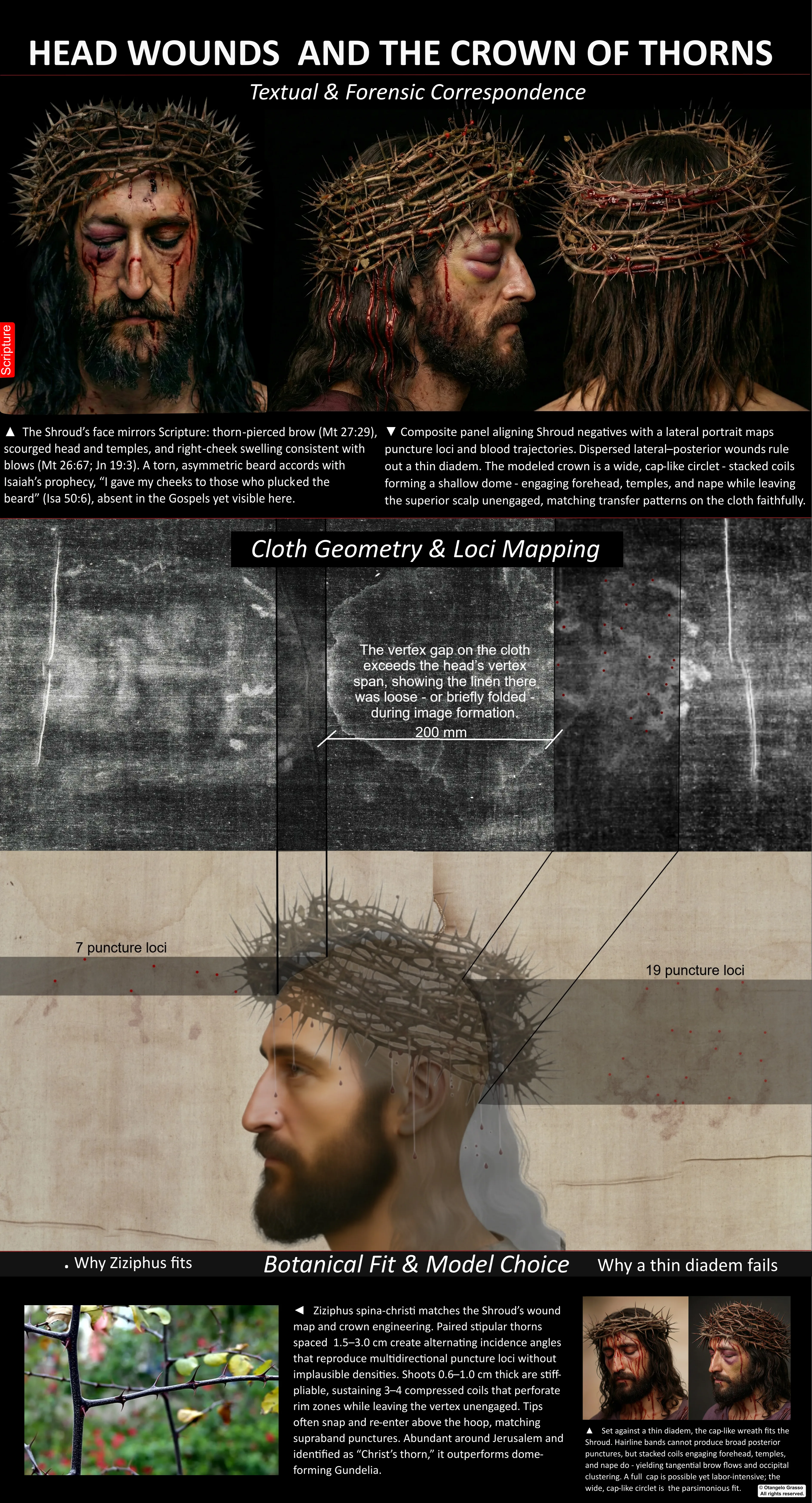
IN-DEPTH READING
Head wounds, Gospel accounts, and the limits of reconstruction
The crown of thorns occupies a distinctive place in the Passion narratives: Roman soldiers mock Jesus as a king, place a thorn crown on him, and strike him. The Shroud of Turin has been read by some observers as preserving blood-like marks around the forehead and scalp. The historical question is whether those marks can be connected to the Gospel episode; the forensic question is what can actually be inferred from their appearance and distribution. This chapter brings together the textual accounts, published observations and experiments, competing circlet and cap-like models, botanical proposals, and the author’s reconstruction papers. It distinguishes what a source reports from what a later investigator infers.
How to read the claims: the Gospels do not describe the Shroud or specify the crown’s construction. The Shroud’s marks have not been comprehensively sampled or mapped under a reproducible, universally accepted protocol. The author’s crown papers and book provide detailed hypotheses and illustrations; they are useful sources for those proposals, but their conclusions are not independent confirmation or settled forensic findings.
1. What the Gospel accounts say
Matthew and Mark place the crown episode in the Roman soldiers’ mockery after Pilate has handed Jesus over. The soldiers gather in the governor’s headquarters, dress him in a robe, put a woven crown of thorns on his head, mock him as “King of the Jews,” and strike him with a reed before leading him away (Matthew 27:27–31; Mark 15:16–20). John also describes the soldiers putting a crown of thorns on Jesus and dressing him in a purple robe; it reports that they come up to him and say, “Hail, King of the Jews,” and strike him (John 19:1–3). Luke does not narrate a crown-of-thorns episode.1
The accounts are theological narratives, not forensic scene reports. They identify the mock-royal action and its humiliating purpose, but do not specify the exact plant, thorn length, number of branches, crown diameter, whether it encircled the brow or covered the scalp, how it was fastened, how long it remained in place, or the number and location of any punctures. “Plaiting” describes an act of weaving or twisting material; it does not by itself determine whether the result was a narrow circlet or a broader cap-like object. No Gospel states that the soldiers used a particular species of thorn bush.
Nor should the crown episode be merged with the flogging as though one text supplied a detailed sequence for every injury. Matthew and Mark place flogging before the mockery; John places the flogging and mockery before Pilate’s final presentation of Jesus. Their narrative arrangements differ. The texts do not say which scalp marks, if any, correspond to the Shroud’s marks. The relationship is an interpretation made by later observers, not an identification made by the Gospel authors.
2. What observers describe on the Shroud
In photographs of the frontal head region, observers have pointed to reddish-brown marks near the forehead and hairline, including a winding mark often called the “reversed epsilon” or “reversed 3.” Other reported marks occur at the sides and in the occipital region on the dorsal image. The labels “blood,” “wound,” “puncture,” and “locus” already involve different levels of interpretation: a visible discoloration is an observation; calling it a stain from blood is a material interpretation; calling it a puncture from a thorn is a causal hypothesis.
The precise number of head marks is not settled. Counts in the author’s sources vary because investigators do not always count the same things: a visible spot, a cluster, paired rivulets, a presumed impact, or an individual alleged wound. The author’s papers and book refer to ranges of roughly 28–37 loci, while other Shroud writers have used different counts. These are not the result of a published, independently replicated census with agreed inclusion rules. A defensible count would need to identify each candidate mark on a specified high-resolution image, provide coordinates and criteria, distinguish obscured or ambiguous areas, and report independent observer agreement.
Photographic enhancement can help reveal low-contrast detail, but it can also change apparent boundaries through contrast, sharpening, color balance, and rescaling. The distinction between the cloth’s visible features and an interpretive overlay matters especially for the supplied banner: its labeled marks and proposed crown arrangement are an author-made diagram. They should be compared with the source photographs and not mistaken for original markings or a scientific measurement.
3. Are the head marks demonstrably blood?
Heller and Adler reported chemical and spectroscopic tests on selected Shroud samples that they interpreted as consistent with blood-related material. Their 1980 paper is important to the history of Shroud testing, but the sample set was small and spatially limited. It does not establish the composition of every mark on the head, identify the person from whom material originated, or prove that a particular mark came from a thorn puncture. A conclusion about a tested fiber cannot automatically be extended to every visually similar feature on the cloth.2
Other researchers, notably Walter McCrone, interpreted material on tape samples as pigments and proposed an artistic explanation. The disagreement involves sample selection, analytical methods, and the interpretation of the results. A careful account reports the competing claims and their scope rather than saying that “science proved” either that all head marks are blood or that every mark is paint. The Shroud’s restricted access and the age and limited location of many samples make a comprehensive modern chemical map difficult.
Even if a reddish mark is blood, its appearance alone cannot reveal the exact injury mechanism. A winding trail might reflect blood flowing over skin or hair, contact between a bleeding area and cloth, movement of the head, later wetting, or more than one process. Without a securely located sample and validated diagnostic criteria, the familiar name “reversed epsilon” is a visual description, not a clinical diagnosis of a named vein.
4. What the modern blood-transfer experiment did—and did not do
König and colleagues’ peer-reviewed study examined possible ways blood stains attributed to the crown, lance wound, and belt could have formed. For the head-stain experiment, a volunteer’s hair was treated with blood and the researchers compared transfer under different conditions. They report that initial transfer differed when blood was still moist versus after drying and coagulation; wetting the hair and applying oil before contact could produce patterns resembling some marks discussed on the Shroud. The experiment therefore shows that a simple assumption—“blood must transfer in the same way under every state of the hair and blood”—is unsafe.3
The paper is explicit about its limits. It did not recreate the exact historical event, test a thorn crown’s penetration mechanics, establish a particular crown shape, or prove that the Shroud stains were produced by the tested process. It explored possible mechanisms under selected conditions. The investigators note limitations including restricted access to the cloth and reliance on photographs and earlier sampling. It is inaccurate to cite this paper as a direct experiment showing thorn breakage, a “triad penetration effect,” or proof of a circlet; those claims go beyond what the published experiment reports.
This result is still useful. It identifies variables that a serious transfer model must account for: whether hair is present, the state and quantity of blood, drying and coagulation, washing or wetting, oiling, contact pressure, movement, cloth weave, and time. A visual resemblance between an experimental stain and a Shroud feature is hypothesis-generating. It is not unique identification, because different combinations of conditions can produce similar patterns.
5. Circlet, cap, or another arrangement?
A narrow circlet is a band around the head. A cap-like or helmet-like model covers some or much of the scalp. These are useful simplified alternatives, but real plant material could form an irregular, open structure between them: branches may cross the scalp, project unevenly, or make contact only at scattered points. A “crown” need not be a continuous surface, and neither model should be treated as if it predicts a tidy, uniform ring of wounds.
Peter Barbet’s influential mid-twentieth-century medical reconstruction favored a cap-like crown to account for marks he interpreted across the scalp. It became a major point of reference in Shroud literature, but it is an anatomical reconstruction based on visual interpretation, not a record of the object used by Roman soldiers. Other authors have proposed a circlet or a lower, irregular arrangement. The distribution of marks is relevant to the debate, but the inference depends on how the marks are identified, how the cloth’s front and back images are registered to a three-dimensional head, and how much of the scalp the proposed object would actually contact.4
A circlet model’s strength is that a perimeter band could create wounds around the forehead, temples, and rear of the head while leaving some central scalp areas relatively untouched. Its challenge is to explain marks interpreted away from that perimeter and the object’s stability during movement. A cap model can explain broad scalp contact more readily, but must account for any apparently less marked region and for how blood would or would not transfer there. These comparisons are conditional: if a candidate stain is not blood, is mislocated, or is not from a puncture, it should not be used as a constraint on crown geometry.
The Shroud cannot, by itself, disclose the material’s species, branch direction, number of coils, fastening method, or the soldiers’ construction time. Those details can be explored in models, but they remain additional assumptions unless supported by independent evidence.
6. The “clean vertex” or bridge argument
The author’s circlet proposal places weight on a relatively faint or apparently unmarked interval between the frontal and dorsal head images, described as the vertex or “bridge.” The argument is that a cap contacting the top of the head should have left a corresponding transfer, whereas a perimeter circlet could avoid that area. This is a potentially testable geometric question, but it is not yet a decisive observation.
The author’s own publications do not give one consistent distance: the book and one paper describe a bridge near 15–16 cm (the book gives 15.7 cm), while the later image-constrained paper describes approximately 20 cm. Those values need a shared definition of the endpoints, cloth coordinates, image scale, head orientation, and measurement uncertainty before they can be compared. The transition between frontal and dorsal image regions is not automatically a literal ruler laid over an upright skull: cloth folds, drape, head flexion, gaps, and the body’s posture affect the mapping.
Most importantly, “no obvious transferred mark in this region” is not equivalent to “the vertex was not injured.” A wound might not transfer visibly; hair can intercept blood; contact may be discontinuous; and a faint image or photographic limitation can conceal detail. Conversely, if a mark exists, it still needs material and causal identification. The vertex argument should therefore be treated as a proposed constraint requiring reproducible mapping, not as proof that a helmet is impossible or that the circlet model has been established.
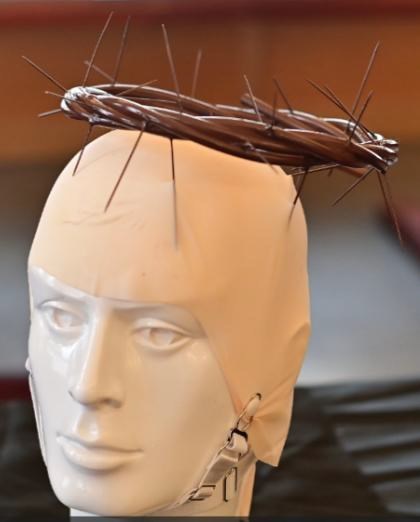
7. What the author’s reconstruction tests
The author’s two crown papers and book develop an image-constrained reconstruction: count and position candidate loci; compare a narrow band with a cap-like arrangement; consider how blood could flow through hair and transfer to linen; and ask whether the frontal and dorsal images can be reconciled with a head and cloth in contact. This is a useful set of questions. It is also a model built from interpreted image features, so its results depend on the accuracy of the inputs.
The accompanying physical demonstration is qualitative rather than a controlled biomechanics study. The paper describes flexible LDPE rods with artificial thorns, a silicone scalp analogue, and a small number of placements. It does not report measured puncture forces, tissue injury depth, blood volume, reproducible placement coordinates, blinded stain classification, or a validated cloth-to-head registration. It therefore demonstrates that a circlet arrangement can be constructed and positioned; it does not establish how an ancient object behaved on a living or recently deceased person.
The author’s botanical and image-constrained paper proposes Ziziphus spina-christi and a multi-coil circlet. These are hypotheses to be evaluated against plant availability, thorn morphology, branch flexibility, and the marks. There is no surviving crown material from the Shroud event with which to identify a species. The central value of the author’s work is to make the proposal concrete enough to discuss and test; its illustrations should not be treated as independent archaeological or forensic evidence.56
The books also collect prior medical and historical interpretations. Here they are used as source guides and for the author’s argument, not as the organizing authority for the episode. Where the book’s categorical wording exceeds the available evidence—such as treating a particular crown shape, exact locus count, thorn species, or injury sequence as settled—the article marks the conclusion as provisional.
8. Can the thorn species be identified?
The Gospel writers name no plant. Ziziphus spina-christi, sometimes called Christ’s thorn jujube, is one proposed candidate because it is a thorn-bearing plant of the eastern Mediterranean and has long featured in Shroud-related botanical arguments. Other thorny shrubs could also be considered. A plant’s regional presence or ability to form a branch ring does not demonstrate that it was used in this particular episode.
Botanical claims drawn from alleged pollen or plant images on the Shroud require special care. The interpretation of such images is contested; an apparent shape in a low-resolution image is not equivalent to a botanically identified specimen. No authenticated first-century thorn, leaf, seed, or branch fragment has been recovered from the crown episode. Even a secure plant identification would not by itself distinguish a circlet from a cap, since the same species could be woven in different forms.7
Accordingly, the species question remains open. A responsible label is “proposed candidate,” not “the plant used.” The site banner’s botanical attribution represents the author’s proposal and should be read with this qualification.
9. The Sudarium of Oviedo comparison
Some authors compare stains on the Sudarium of Oviedo—a separate cloth venerated in Spain—with the Shroud’s head-area marks. They argue that stain patterns, folding, or proposed three-dimensional point-cloud correspondences may be compatible with the same head or sequence of handling. Such work can suggest measurable questions, but a match depends on choices about which marks correspond, how the cloths were folded, which surfaces faced the head, the scale and orientation of each image, and what counts as a successful fit.
The comparison is not independent proof of the Shroud’s identity or of a crown shape. The two cloths have different histories, materials, image records, and access conditions. A claimed geometric correspondence should be assessed with published source images, fixed registration procedures, uncertainty estimates, and testing by researchers who did not choose the matching points. The author’s point-cloud and stain-alignment discussion is one proposed interpretation; the phrase “independent corroboration” would overstate what it can establish without such independent validation.8
10. The Crown of Thorns relic and its historical limits
The Crown of Thorns venerated in Paris belongs to the history of medieval Christian relics. The crown and other Passion relics are associated with Louis IX’s acquisition of relics in the thirteenth century and the construction of Sainte-Chapelle. That documented medieval history is important for understanding devotion, royal politics, and the relic’s later custody. It does not provide a continuous, independently documented chain back to the Roman execution in the first century.9
The relic’s present form and the descriptions of its history cannot settle what the soldiers made. A ring or woven circlet in a later relic tradition is not proof that the Shroud’s marks came from the same object or arrangement. Conversely, the history of the relic does not disprove the Gospel episode. The relic record and the Shroud’s image are separate evidentiary questions.
11. Evidence assessment: what can responsibly be concluded?
| Question | What the evidence supports | What remains unestablished |
|---|---|---|
| What do the texts report? | Matthew, Mark, and John narrate a crown of thorns in the soldiers’ mockery; Luke omits the scene. | Plant species, exact shape, number of thorns, duration, and a forensic connection to the Shroud. |
| What is seen on the Shroud? | Observers identify reddish-brown head-area marks and describe their visible patterns. | A consensus census of loci, identity of every mark, and a validated map of each wound. |
| What did blood tests establish? | Published investigators reported blood-consistent results on selected samples. | That every head mark is blood, who it came from, or how and when it arrived on the cloth. |
| What did the recent experiment show? | Different blood, hair, wetting, and oil conditions can produce differing transfer patterns; some resemble marks discussed on the Shroud. | The exact historical process, the crown’s construction, or the Shroud’s authenticity. |
| Which crown model fits? | Circlet and cap-like arrangements generate testable predictions when mark locations and cloth geometry are specified. | A decisive model choice based on an agreed image map and reproducible physical testing. |
| Which plant was used? | Ziziphus spina-christi is one proposed regional candidate. | Species identification from authenticated episode material. |
The strongest conclusion is modest but meaningful: the Gospel tradition describes a mock crown of thorns, and some Shroud observers interpret head-area marks as compatible with bleeding from thorn injuries. Published tests and experiments make blood transfer a scientifically discussable problem. They do not establish a unique crown geometry, a specific plant, the identity of the person, or the historical origin of the cloth. The circlet and cap models remain reconstructions whose value depends on transparent measurements and experiments that others can reproduce.
References
- The Holy Bible, New Revised Standard Version Updated Edition: Matthew 27:27–31; Mark 15:16–20; John 19:1–3; Luke 23:11. Read the passages.
- Heller, J. H., and A. D. Adler. “Blood on the Shroud of Turin.” Applied Optics 19, no. 16 (1980): 2742–2744. https://doi.org/10.1364/AO.19.002742.
- König, L., R. Schmölders, M. Jühling, A. Reckert, A. Heger, and S. Ritz-Timme. “Some Experiments and Remarks Regarding the Possible Formation of Blood Stains on the Turin Shroud: Stains Attributed to the Crown of Thorns, the Lance Wound and the Belt of Blood.” International Journal of Legal Medicine 138 (2024): 229–238. Published online 2023. DOI · Full text at PubMed Central.
- Barbet, Pierre. A Doctor at Calvary: The Passion of Our Lord Jesus Christ as Described by a Surgeon. New York: P. J. Kenedy, 1953. Catalog record. A historically influential medical interpretation; not a contemporary examination of the Shroud.
- Grasso, Otangelo. “Crown of Thorns: Circlet or Helmet?” Author’s research paper, written with AI assistance, 21 October 2025. Download the author’s paper (PDF). Its model and qualitative demonstration are proposals, not independently validated experimental results.
- Grasso, Otangelo. “Crown of Thorns on the Turin Shroud: Image-Constrained Architecture and Botanical Attribution to Ziziphus spina-christi.” Author’s research paper, written with AI assistance, 24 October 2025. Download the author’s paper (PDF).
- Danin, Avinoam. Botany of the Shroud of Turin. Jerusalem: Danin Publishing, 2010. See also the author’s paper on proposed plant images and pollen: Shroud.com copy. Botanical interpretations of image-like forms remain disputed.
- Sánchez Hermosilla, A. “Commonalities between the Shroud of Turin and the Sudarium of Oviedo.” SHS Web of Conferences 15, 00009 (2015), Sindone 2014. Article PDF. The paper itself notes the lack of agreed protocols for investigating these archaeological textiles.
- Institut de recherche et d’histoire des textes (CNRS). Vexilla Regis Glorie, on Louis IX’s acquisition of the Crown of Thorns and other Passion relics and the Sainte-Chapelle. CNRS publication record; see also the Sainte-Chapelle’s institutional history.
- Grasso, Otangelo. Forensic Summary, 3rd ed. The book’s Chapter 9 discusses the crown marks, circlet hypothesis, and proposed vertex measurement. Find the book on Amazon. Used here as a source for the author’s argument; claims are assessed against the cited primary literature.
- Grasso, Otangelo. From Forensics to Faith (2026), chapter “Head Wounds, and the Crown of Thorns.” Find the book on Amazon. Interpretive synthesis, not independent experimental confirmation.
- Zugibe, Frederick T. The Crucifixion of Jesus: A Forensic Inquiry. Revised ed. New York: M. Evans, 2005. Publisher’s page.
- Rodante, Sebastiano. “The Coronation of Thorns in the Light of the Shroud.” Shroud Spectrum International 1 (December 1981): 5–24. Available scan. A sindonological interpretation.