IN-DEPTH READING
The Shroud as a digital image
Digital tools can make a faint image easier to inspect and can turn tones into a three-dimensional display. But the image on a screen is the result of both the cloth and the choices made by the person processing it. This article follows those choices step by step.
What “digital autopsy” means here
“Digital autopsy” is a metaphor for examining a digital representation of the Shroud’s body image. No body is dissected, no new sample is taken from the cloth, and the software does not directly recover a hidden person. The work begins with photographs or scans, then uses image editing, contrast changes, overlays, modeling, or generative image tools to make an interpretation visible. The word autopsy can sound more conclusive than the method is; what follows is a digital reconstruction exercise, not a forensic identification.
The distinction matters because several different operations are often grouped together as “image analysis.” A photograph records light reflected from a cloth. Contrast enhancement remaps recorded brightness values. A relief display assigns height to those values. A 3-D model represents a body with chosen geometry. An AI image generator can invent plausible surface detail from patterns learned from other images. Each can be useful, but each answers a different question.12
From the photographic negative to the computer screen
Photography changed how people saw the Shroud. In 1898, Secondo Pia’s glass-plate photograph showed the cloth’s faint tonal image as a more legible positive when the negative was viewed. That discovery is a historical starting point for modern image study, but it did not provide a digital depth map or establish how the image had formed. A photographic negative is a reversal of tone; it is not, by itself, a three-dimensional reconstruction.
A different line of inquiry began with the VP-8 Image Analyzer in the 1970s. The instrument converted variations in image brightness into a relief-like display. In 1984, John Jackson, Eric Jumper, and William Ercoline published a quantitative study of the relation between image intensity and a proposed cloth-to-body distance map. Their paper examined whether the Shroud image, when interpreted with a particular distance assumption, produced a coherent body-shaped relief. It did not claim to have scanned the body itself, and it did not prove that the image was made by a body. The result depended on how image values and reference distances were selected and mapped.1
The material properties of the image are a separate subject. STURP’s 1978 investigation used photography, spectroscopy, microscopy, and other methods to study the cloth. The resulting literature describes an unusual, very superficial linen discoloration and records disagreements about its interpretation. A computer-generated portrait cannot resolve those chemical questions: it works on a digital picture, not on the linen fibers or their chemistry.2
The first experiment: sharpening a faint face
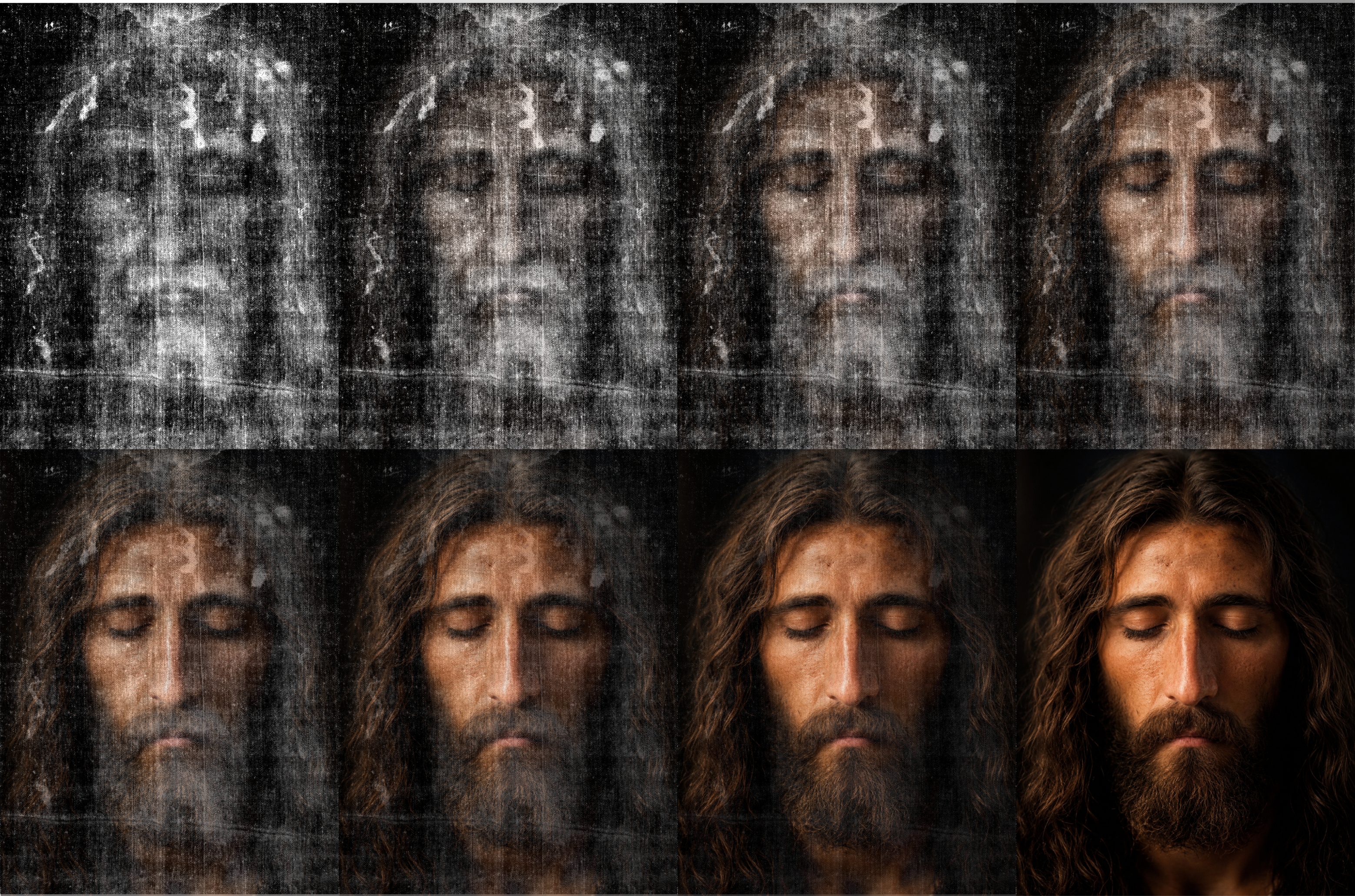
The project described in the source material began in October 2022 with a modest test: apply a consumer image-sharpening tool to a colorized Shroud image and see whether facial contours became easier to perceive. The result prompted further exploration. This is a useful, concrete account of how the work began, but sharpening is not a neutral window into hidden detail. It increases local contrast and edge definition; depending on the source image and settings, it can also exaggerate noise, fabric texture, stains, or compression artifacts.
A responsible reading therefore asks two questions. First, what feature is already present in the original image at the same location? Second, does the feature persist when the processing method, source photograph, or display settings change? A detail visible only after a particular filter has been applied should be described as a processing-dependent appearance, not as a newly discovered anatomical fact. Research on low-contrast Shroud images has specifically warned that processing can lead viewers to perceive patterns that are not securely present in the original data.3
The workflow: prepare, interpret, compare
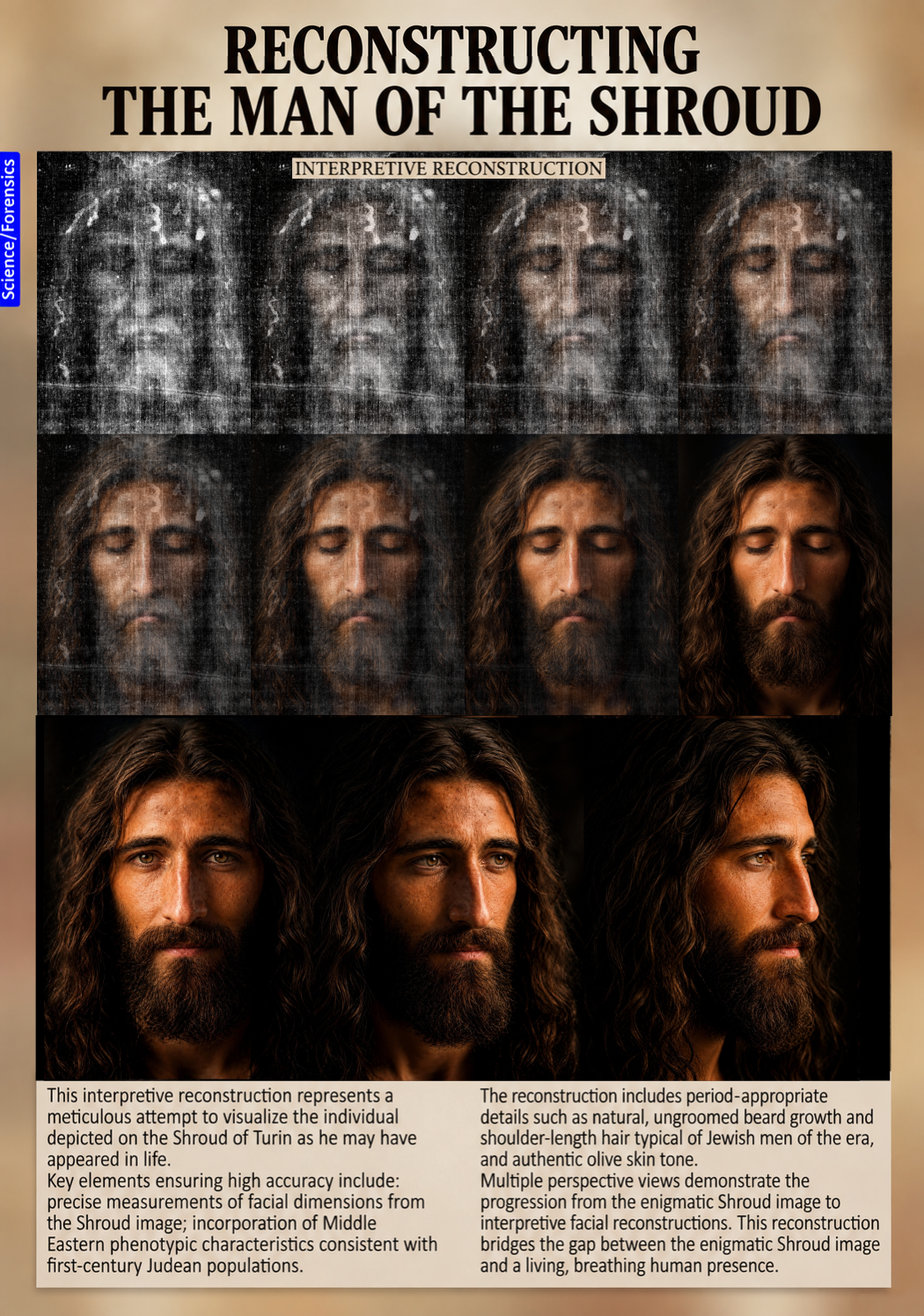
The reconstruction account describes a series of steps rather than one automatic conversion. The same project is documented in the author’s independent 2025 reconstruction paper and in a chapter of his later forensic survey; those texts are sources for the workflow, not independent scientific validation.78 The source image was prepared using positive and negative views, image-editing tools, and efforts to reduce the visual interference of weave, discoloration, burns, and water marks. Candidate human forms were then produced and adjusted. Finally, the candidate images were placed over Shroud photographs at partial transparency so the two could be compared visually.7
Every step contains a choice. Which photograph is used? Is the image cropped, rotated, stretched, or rescaled? How are the cloth’s herringbone texture, repairs, burn marks, and folds handled? Which regions are considered body image, blood, or background? What contrast or color adjustments are made? If a generated face is chosen from many alternatives, which one is retained and why? Those choices need to be documented because the final overlay alone does not reveal them.
Image registration is especially important. Two layers must be matched for scale, position, orientation, and perspective before apparent agreement can be judged. A viewer can then compare visible landmarks—such as the face outline, shoulders, arms, or legs—but visual overlap is not yet a numerical test. To become reproducible evidence, the comparison would need defined landmarks or image regions, a stated alignment procedure, error measurements, and a record of the alternatives that did not fit.
What an overlay tests—and what it does not
A semi-transparent overlay is a helpful demonstration: it lets readers see the source photograph and the proposed model at once. It can expose an obvious mismatch and show how the author understands the correspondence. It is not an independent validation if the model was repeatedly edited until it matched the same image being used to judge it. In that situation, the source image guides the construction and then is used to confirm the construction. The comparison may show internal consistency, but it cannot by itself establish that the model is the unique or objectively recovered body represented by the cloth.
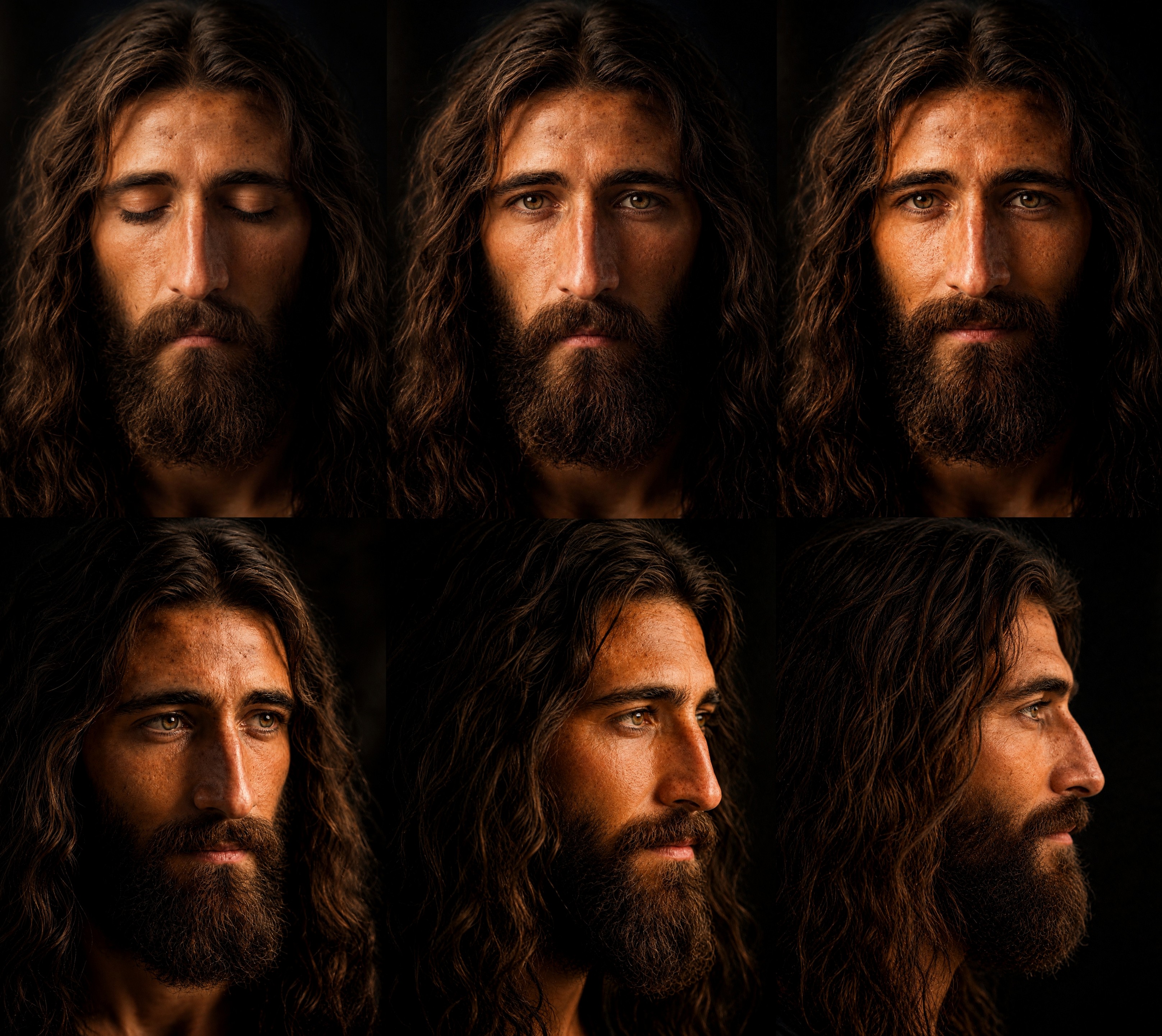
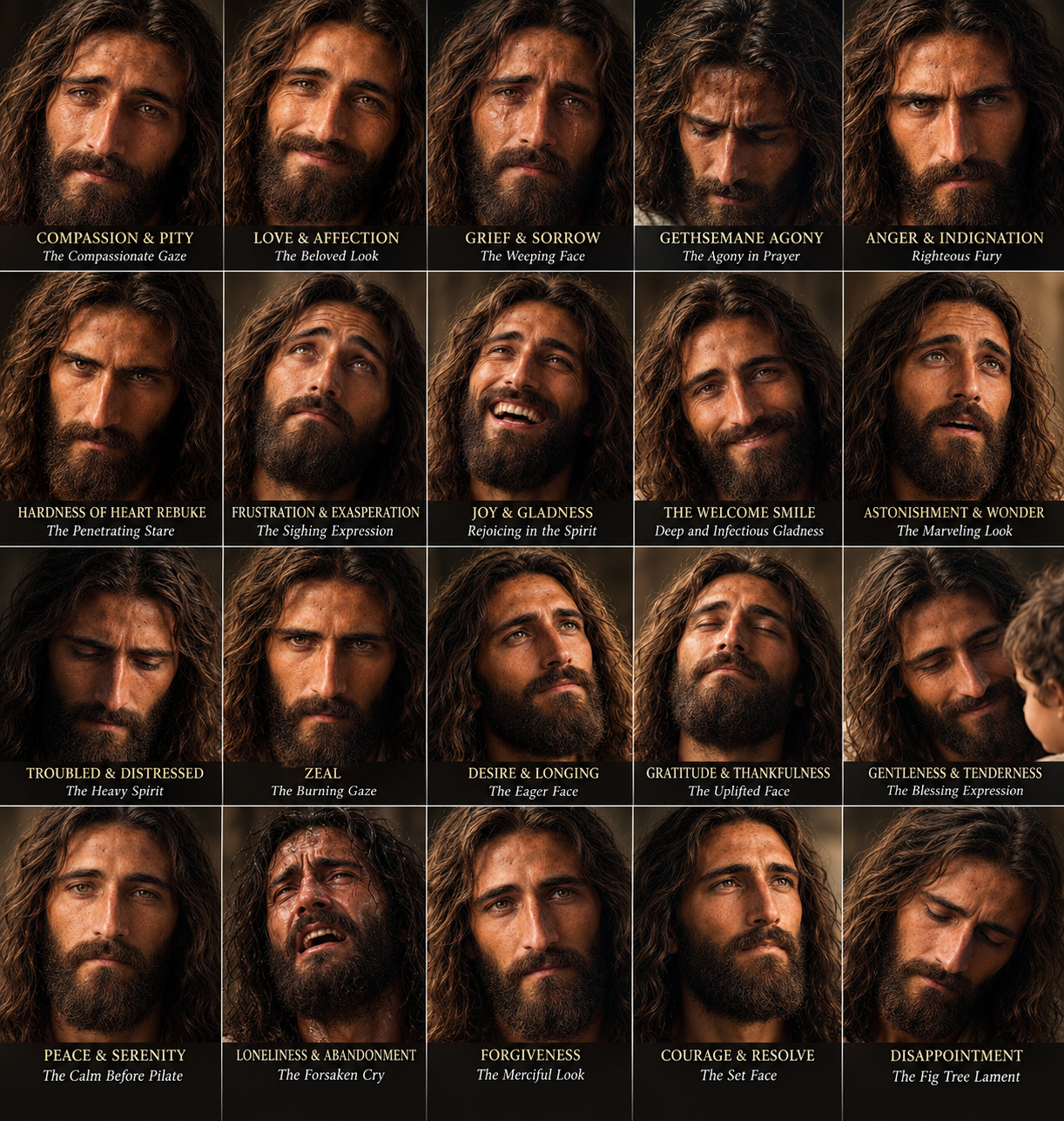
This is particularly important for generative AI. Such a tool can create convincing skin, hair, facial expression, wounds, and lighting. These details may make an image easier to understand, but their realism comes from the model’s learned visual conventions and the user’s instructions, not necessarily from information encoded in the Shroud. A plausible-looking ear or eyelid is not evidence that the cloth preserves that feature. The same caution applies to age, ethnicity, complexion, musculature, and expression: unless a trait is clearly observable in the source data, a reconstruction should label it as an artistic or model-based choice.
The source book documents successive face and body stages, including the degradée sequence and semi-transparent comparisons. These are valuable as a record of the author’s working hypothesis. They should be captioned as interpretive reconstructions, with the original image kept visible wherever possible, rather than presented as photographs of the historical man.7
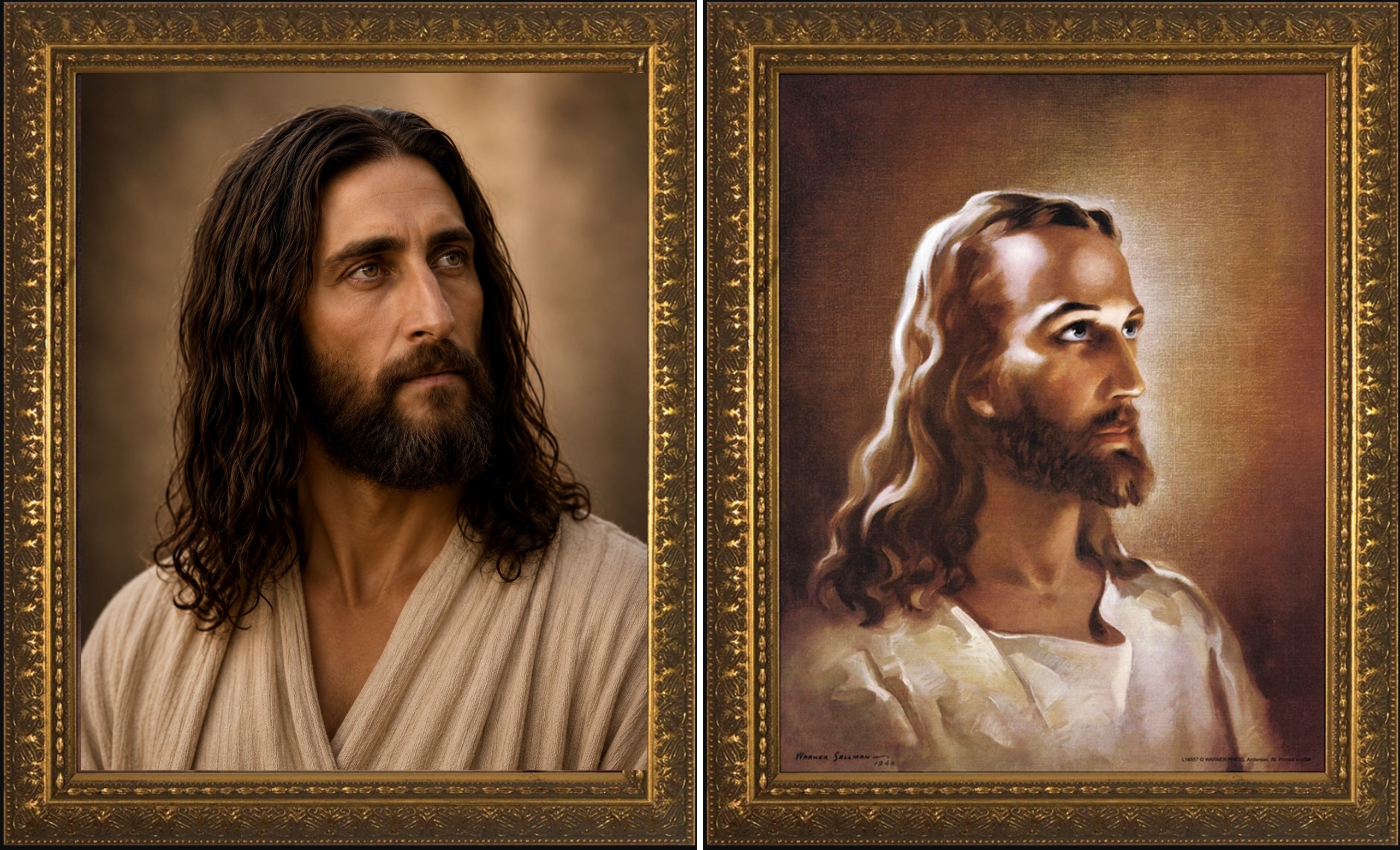
Digital 3-D models are not all the same
There is also a broader digital-modeling debate. Jackson, Jumper, and Ercoline studied relief generated from brightness and a proposed distance relationship. Luigi Garlaschelli’s experimental paper showed that a deliberately produced Shroud-like image could also yield a relief-like result when processed with commercial software, and emphasized that the output depends on the initial image and software settings. These approaches do not use the same inputs or test the same hypothesis. Together they show why a striking relief display should not be treated as a direct scan of a body or a self-interpreting proof of origin.14
In 2025, Cicero Moraes published a different kind of digital experiment: he modeled cloth draping over a three-dimensional human form and over a low-relief form, then compared the simulated patterns with Shroud photographs. He argued that the low-relief simulation better matched the contours he selected. The proposal drew published criticism that the simulation did not establish the proposed origin and omitted important features of the artifact; Moraes later published a response. This exchange is a reminder that a digital model is only as persuasive as its assumptions, inputs, comparison criteria, and handling of contrary evidence.56
What would make the method stronger?
A more testable digital reconstruction would publish the highest-quality source photographs it is legally able to share, identify which parts are scans and which are generated or retouched, and preserve an untouched copy of each input. It would list software, settings, prompts, crops, masks, and every major editing decision. It would separate measured landmarks from inferred anatomy, explain how overlays were registered, and give quantitative fit measures rather than relying only on a viewer’s impression.
Independent researchers should be able to repeat the workflow from the same source material and report both successful and unsuccessful fits. A useful test would also compare the proposed body with reasonable alternatives, use landmarks not used during model fitting, and invite blinded reviewers who do not know which candidate is favored. Such safeguards would not settle the Shroud’s age or image-formation mechanism, but they could establish whether a particular reconstruction is reproducible and how much information the source image actually constrains.
A visualization, not an identification
Digital processing can help people inspect faint patterns and understand proposals that are difficult to picture from prose alone. A carefully labeled reconstruction can therefore be useful. The present workflow records a sustained attempt to turn Shroud photographs into a coherent face and body model. Its strongest contribution is as an explicit, inspectable visualization of one interpretation.
The limits are just as clear. Image enhancement cannot create independent data; a 3-D relief is not a direct scan; an overlay does not validate a model if the same image shaped the model; and generative detail should not be mistaken for evidence. The digital “autopsy” does not establish who the man was, when the cloth was made, what caused its image, or whether the reconstructed appearance is uniquely determined by the linen. Those questions require evidence and methods beyond a compelling image on a screen.
SOURCES & FURTHER READING
References
- Jackson, J. P., Jumper, E. J., & Ercoline, W. R. (1984). “Correlation of Image Intensity on the Turin Shroud with the 3-D Structure of a Human Body Shape.” Applied Optics, 23(14), 2244–2270. Article record and abstract.
- Schwalbe, L. A., & Rogers, R. N. (1982). “Physics and Chemistry of the Shroud of Turin: A Summary of the 1978 Investigation.” Analytica Chimica Acta, 135, 3–49. Article record; overview of the 1978 examination.
- Di Lazzaro, P., Murra, D., & Schwortz, B. (2013). “Pattern Recognition after Image Processing of Low-Contrast Images, the Case of the Shroud of Turin.” Pattern Recognition, 46(7), 1964–1970. Article record; ENEA record.
- Garlaschelli, L. (2010). “Life-Size Reproduction of the Shroud of Turin and Its Image.” Journal of Imaging Science and Technology, 54(4), 040301. Article DOI.
- Moraes, C. (2025). “Image Formation on the Holy Shroud—A Digital 3D Approach.” Archaeometry, 68(1), 84–93. Article DOI; associated data.
- Casabianca, T., Marinelli, E., & Piana, A. (2026). “Commentary on the Article ‘Image Formation on the Holy Shroud—A Digital 3D Approach’ by Cicero Moraes.” Archaeometry, 68(4), 861–863. Commentary DOI; Moraes, C. (2026), “Response to the Comments of Casabianca et al. (2025).” Response DOI.
- Grasso, O. (2025). The Shroud Reimagined: A Forensic Reconstruction. Author’s account of the 2022–2025 digital reconstruction workflow and the source illustrations reproduced here. This is an independent project report, not a peer-reviewed validation of its conclusions. Download the author’s PDF.
- Grasso, O. The Shroud of Turin: A Forensic Summary of the Evidence, 3rd ed., Chapter 7, “The Digital Autopsy—Reconstructing the Man in the Shroud,” pp. 132–145. Source chapter with the expanded process account and illustrations. Book information.