A CLOSER LOOK · ENVIRONMENTAL TRACES
What can a grain of dust actually tell us?
The Shroud carries material besides linen: particles that may record contact with people, places, rooms, plants, and objects. The puzzle is not simply to name them. It is to reconstruct how they arrived—and how securely that history can be recovered.
Pollen and mineral particles have been invoked to place the cloth in the eastern Mediterranean, and especially in Jerusalem. The argument is attractive because pollen is botanical and minerals are geological: two kinds of evidence that seem to point in the same direction. But they come from different sampling episodes, and the identity, location, and handling history of the particles are not equally well documented. This article follows the chain from the 1970s collections through later re-examinations, including the strongest supporting interpretations and the main objections.
The distinction running through the discussion is between compatibility and proof. A particle may be compatible with a region without being unique to it. A plant may grow near Jerusalem without showing that the cloth was there. And even a securely identified trace cannot date itself: its age depends on when it entered the cloth’s accumulated surface record.
1. An environmental archive is not an itinerary
Textile surfaces collect and retain material. A linen cloth may acquire pollen from air, plants, clothing, storage materials, dust, display environments, repairs, and human contact. Mineral grains can be transferred in dust, from a surface on which the cloth rests, or through handling. A cloth used and displayed for centuries is therefore an archive of repeated contact, not a sealed archaeological deposit.
Several kinds of observation appear in the Shroud literature and must not be merged. A pollen grain examined on adhesive tape is a physical microfossil; a plant shape proposed in a photograph is a visual interpretation; a calcium signal measured across cloth is an elemental observation; and a mineral particle compared with a geological sample is a source hypothesis. Each requires its own method and controls. Agreement among them is meaningful only to the extent that the measurements are reliable and their sources are independent.
In particular, pollen does not ordinarily function as a time stamp. Pollen can persist for long periods, but persistence says nothing by itself about when a particular grain was deposited. A taxonomic identification can suggest the plant family, genus, or species; a distribution map can indicate where that plant grows today; neither step alone identifies the route or date of the cloth.
2. The collections: who sampled what, and when?
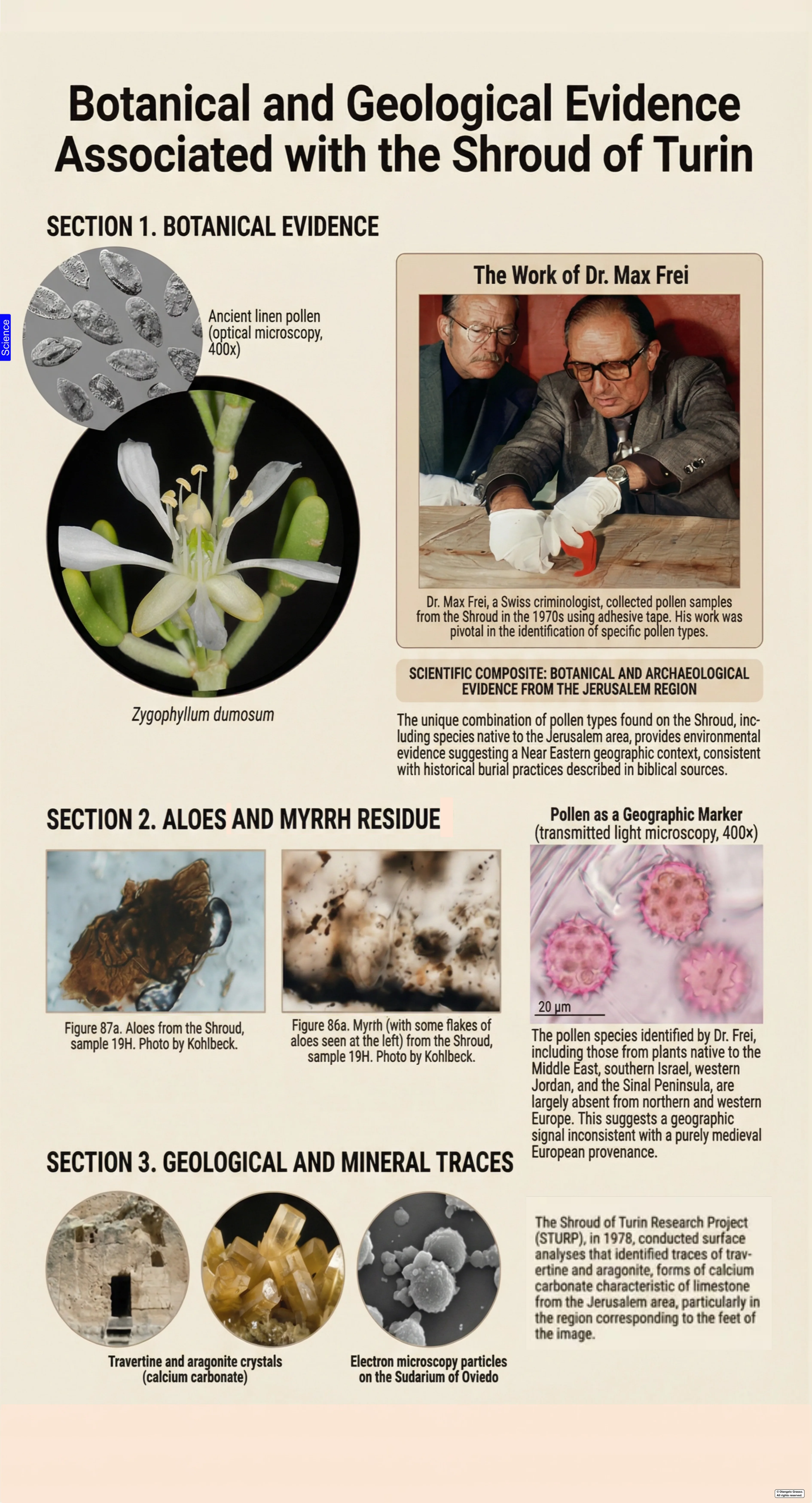
Swiss criminologist Max Frei-Sulzer took adhesive-tape lifts from accessible areas of the Shroud in 1973 and again during the 1978 examination period. Pressing tape against a surface is a familiar trace-evidence technique: loose fibres and particles adhere to it and can later be viewed under a microscope. Frei’s samples were his own investigation, distinct from STURP’s coordinated examination and its separately designed sampling procedures. Frei died in 1983 before completing the fuller pollen monograph he had planned. Accounts of sample totals vary across publications; the later Danin–Baruch tally describes the material they reviewed rather than a complete census of every surviving tape.12
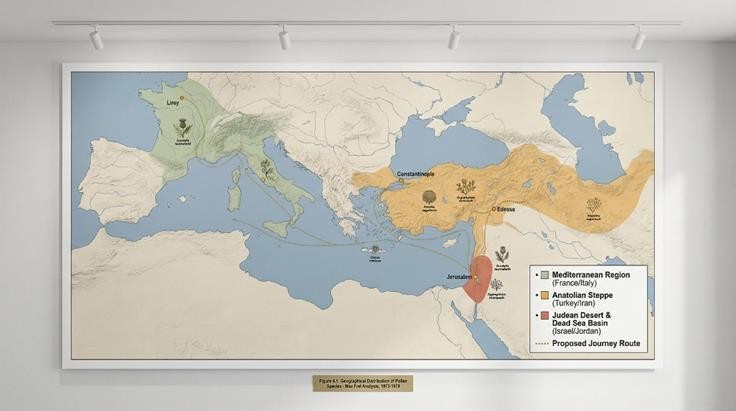
Frei compared grains on the tapes with reference pollen he collected while traveling in parts of the eastern Mediterranean and Europe. His published accounts assigned grains to plants associated with several regions and argued that the assemblage preserved traces of a journey from the Holy Land through Anatolia and Constantinople to western Europe. This was a reconstruction, not a route directly observed in the samples. Its force depended on three propositions: that the grains were correctly identified; that their modern distributions adequately represented the relevant past; and that they entered the cloth during the proposed earlier journey rather than during later handling or storage.
There is also a sampling-history complication. Frei’s material was retained and later examined by researchers working from the surviving slides. The later observers did not take fresh, controlled samples from the cloth. Their work can reassess what is visible on the preserved tapes, but it cannot retrospectively add the environmental blanks, handler profiles, room samples, and tape-by-tape chain-of-custody records that a modern trace-evidence study would seek.
3. Frei’s interpretation: a proposed route from Palestine to Europe
Frei grouped his reported plants into ecological and geographical categories—desert and salt-tolerant plants, rocky-ground flora, Mediterranean plants, Anatolian steppe flora, plants associated with Constantinople, and broadly distributed European or cosmopolitan plants. He interpreted the range as an accumulated sequence of exposures. The original account was presented as a way of connecting microscopic traces to the Shroud’s proposed historical movements, and it influenced subsequent books and popular presentations.1
Two names became especially prominent in later discussion. Gundelia tournefortii, a thorny Asteraceae plant distributed across parts of the eastern Mediterranean and western Asia, was reported as a major pollen type. Zygophyllum dumosum, a shrub of the southern Levant and nearby regions, was cited as a geographically suggestive plant. Supporters argued that the combination could be consistent with exposure in the Jerusalem–Jericho region and that some of the plants flower in spring. Danin and colleagues later used plant distribution and flowering information to propose a Jerusalem-area origin and a springtime presence.2
Those conclusions involve several inferential steps. A plant’s range is not a point location: Gundelia is not confined to Jerusalem, and a pollen type identified only to a family or genus is less geographically precise than a secure species identification. A flowering season can identify when pollen might be produced, but cannot date when a grain landed on a cloth that may have been handled or displayed later. Frei’s route is thus best described as a historical interpretation of his identifications, not an independently documented itinerary.
4. The 1999 re-examination: 313 grains, with limits
In 1999, botanist Avinoam Danin, palynologist Uri Baruch, and Alan and Mary Whanger published a detailed account of pollen and proposed plant images. Their pollen count covered 313 grains on the Frei material they examined: 204 were assigned to identifiable types and 109—34.8 percent—were left unidentified. Their table lists 91 grains as Gundelia tournefortii, or 29.1 percent of all 313 counted grains and 44.6 percent of the identified grains. Other reported categories included Cistaceae, Apiaceae, and several common or broadly distributed types.2
The authors argued that the combination of plants, especially the Gundelia and Zygophyllum reports, was compatible with the Jerusalem region and that some plant images on the cloth supported the same conclusion. Their work made a real contribution by publishing a count and a taxonomic table rather than relying solely on Frei’s earlier summary. At the same time, it was a reanalysis of Frei’s existing tape material, not a fresh sampling campaign. It therefore did not independently establish how or when each pollen grain reached those tapes.
The distinction between “identified” and “identified to species” also matters. In the table and later review, some of Frei’s names were reduced to genus or family; some could not be confirmed; and several taxa remained tentative. Baruch’s later examination notes, reproduced in Danin’s botanical work, explicitly qualify a number of earlier species-level assignments. Any geographic argument should therefore use the actual level of identification recorded for each grain rather than repeat the most specific name in a secondary summary.3
5. Identification and contamination: the central dispute
Pollen identification relies on features such as size, shape, apertures, and the sculpture of the outer wall. Closely related plants can have overlapping morphology; waxes, debris, or adhesives may obscure diagnostic features. A statement at family level—such as “Asteraceae”—does not establish a particular species. Species-level claims require enough visible characteristics, suitable reference material, and a reproducible method.
The 1999 result is often summarized by saying that almost one third of all pollen was Gundelia. That is what the Danin–Baruch table reports. In a 2017 paper, Marzia Boi re-examined published images and proposed that the most abundant Asteraceae grains were better assigned to Helichrysum than to Gundelia. Boi compared the published images with reference material using optical and scanning electron microscopy. Her paper is a reasoned alternative identification from images and reference pollen; it was not a new blinded examination of the original complete sample set, and it does not settle the matter by itself.4
Other researchers have challenged the confidence of the species identifications and emphasized the tapes’ limits. In the account of Thomas Litt’s 2001 examination, confocal microscopy showed waxes covering features of the grains; Litt said that he could not make precise genus-level identifications from the slides he saw and that he could probably exclude Gundelia for the examined type. This was a limited review of selected slides, reported through Danin’s later discussion rather than a comprehensive peer-reviewed publication with a full raw-data release. It is important counterevidence, but its scope should not be overstated either.3
Vaughn Bryant’s published review of Flora of the Shroud of Turin raised methodological and taxonomic objections, including the challenges of identifying grains embedded in adhesive and the need for specialist palynological review. Frei’s presentation of some comparison pollen in published illustrations also drew criticism: the issue is whether readers can distinguish reference images from actual Shroud grains and reproduce the identifications. None of these concerns proves deliberate error or contamination. They do mean that confidence should rest on demonstrated sample provenance and independently verifiable morphology, not on the reputation of an investigator or the narrative fit of a proposed route.5
Contamination is not a single alternative explanation; it is a family of possible transfers. A grain may arrive through airborne dust, a visitor’s clothing, storage beside another object, a repair or conservation episode, a sampling tool, a laboratory surface, or direct contact with a plant. Wind-pollinated grains may travel farther, whereas insect-pollinated plants are more likely to transfer through contact. That difference can help evaluate pathways, but it does not rule out later handling or establish the time of deposition. Frei’s tapes lack the full set of contemporaneous controls needed to quantify these pathways.
6. Boi’s alternative: could pollen reflect aromatic materials?
Boi proposed a different question: perhaps some pollen was carried to the linen in oils, resins, or other botanical preparations rather than recording the cloth’s passage through a series of landscapes. The article discusses Helichrysum, Cistaceae such as Cistus, Apiaceae, and Pistacia in relation to plant-derived aromatic products and ancient practices. It also reviews classical botanical sources and the Gospel of John’s reference to myrrh and aloes in the burial narrative (John 19:39–40).4
This is an interpretive proposal, not a chemical identification of an ointment on the Shroud. A pollen grain could be associated with a plant product, but to demonstrate that route one would need to identify the residue itself, establish that it contains the relevant botanical material, and show that the pollen is not a later addition. Nor does evidence that ancient people used aromatic substances establish that this particular cloth received them. The historical context makes the hypothesis intelligible; it does not turn it into an observation.
The two readings—geographic tracer and possible ritual residue—are not fully exclusive. A plant product could originate in a region and later be used elsewhere; pollen could also enter through unrelated exposure. The available tape record does not determine which mechanism accounts for a particular grain. The careful formulation is that Boi offers an alternative explanation for the pollen pattern and a testable direction for further work, while the proposed funerary interpretation remains unconfirmed.
7. Pollen grains are not flower images
The Shroud literature also includes reports of faint plant-like forms in photographs of the cloth. Danin and the Whangers proposed images of flowers or plants, including Gundelia and Zygophyllum, using visual comparison techniques. These claims are separate from the microscopic pollen count: they involve selecting faint shapes in photographs and matching them to botanical forms. A pollen identification cannot validate a photographed silhouette, and a silhouette cannot independently validate a pollen identification.2
Image enhancement and pattern matching can reveal structures, but faint shapes are vulnerable to selection effects and pareidolia—the tendency to perceive familiar objects in ambiguous patterns. The proposed plant images have not become a generally accepted botanical identification. Researchers who wish to establish them would need to publish the source images, the enhancement steps, the selection criteria, and blind comparisons against plausible alternative shapes. This article therefore treats them as hypotheses in the literature, not confirmed impressions left by flowers on the linen.
8. Vacuumed dust and DNA: evidence of accumulated contact
The 1978 examination generated another material record. Giovanni Riggi di Numana used a small vacuum device to collect particles from selected areas, producing dust retained in collection stubs. This is not the same sample as Frei’s adhesive-tape collection. Vacuumed material is a mixture: fibres, mineral particles, pollen, spores, biological debris, and material accumulated through earlier exposure and the collection process.
In 2015, Gianni Barcaccia and colleagues analyzed DNA recovered from dust samples associated with the 1978 collection. They reported a mixture of human, plant, animal, and microbial sequences, including lineages that could not be assigned to the cloth’s original manufacture or use. The authors discussed the possible geographic significance of some human lineages, but the samples represented accumulated dust and contact, not DNA securely tied to the body image or a datable event. A DNA sequence from a mixed dust sample does not by itself identify when, where, or by whom it was deposited.6
A 2026 study examined twelve items from the official 1978 sample collection—linen fragments, vacuum-dust jars, and a biological fragment—using sequencing and proteomic approaches. It found a heterogeneous mixture of human and environmental material. The predominant human mitochondrial lineage matched the collector, Pierluigi Baima Bollone; genome-wide analyses also linked several samples to him or a close relative. The authors discuss both ancient-DNA damage patterns and modern contamination, and conclude that the mixed signals make it difficult to isolate any original human DNA. These findings are directly relevant to sample history: they demonstrate substantial handling contributions in the material studied. They do not re-identify Frei’s pollen or locate the Shroud geographically.7
The DNA studies reinforce a basic caution: a cloth’s biological traces can preserve many episodes at once. That complexity is useful evidence of contact and contamination dynamics, but it weakens any attempt to read every organism as a marker of the cloth’s first location. DNA and pollen are different materials, collected and analyzed by different methods; the later DNA results cannot retroactively validate or invalidate a particular pollen grain.
9. Kohlbeck and Nitowski: the travertine-aragonite proposal
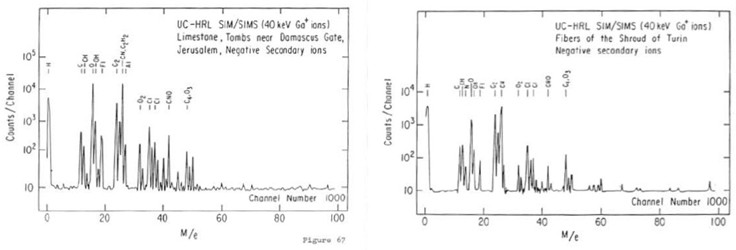
The mineral argument developed separately. In 1978, STURP participants observed particulate material on and near the cloth. Joseph A. Kohlbeck, an optical crystallographer, later examined selected tape material supplied by Ray Rogers. Working with archaeologist Eugenia Nitowski, he compared particles associated with the Shroud—especially material reported from the dorsal foot area—with limestone samples collected in Jerusalem. In 1986, Kohlbeck and Nitowski described the Shroud particles as travertine aragonite and reported qualitative similarities in elemental profiles, including calcium, iron, and strontium. They proposed that the comparison was consistent with contact with Jerusalem tomb material.8
Aragonite is a crystal form of calcium carbonate, distinct from calcite. “Travertine aragonite” describes a mineral produced in particular carbonate-depositing environments. Identifying aragonite is more specific than detecting calcium alone, but it is not a geographical address. Similar mineral phases can form in different places. To identify a unique source, investigators would need a sufficiently broad comparison set, reproducible particle identifications, quantitative compositional measurements, and a demonstration that the proposed signature discriminates Jerusalem from other candidate regions.
The 1986 report appeared in Biblical Archaeology Review, a public-facing archaeology magazine, rather than a peer-reviewed mineralogical journal. Nitowski’s Environmental Study of the Shroud in Jerusalem (ESSJ) field and laboratory report describes a wider comparison of samples collected at nine Israeli sites. It is valuable documentation of the investigators’ fieldwork, but it was not published as a peer-reviewed journal article and has not received the independent replication that would make its conclusions broadly testable. The reported control series should be cited as the team’s own report, not as a result established by an independent review.9
Critic Hugh Farey has examined the published graphs and questioned whether they establish a close quantitative match. He points to the difficulty of evaluating small, adapted plots, differences in elemental profiles, and the fact that the results do not provide a unique Jerusalem marker. He also notes that claims about particles at the nose and knees are not supported by the same direct tape sampling described for the foot area. The critique does not disprove the aragonite identification, but it identifies what the published comparison does not yet demonstrate: a reproducible, geographically exclusive match.10
10. STURP’s X-ray fluorescence survey: elements, not a place name
Morris, Schwalbe, and London published STURP’s X-ray fluorescence (XRF) investigation in 1980. The team measured trace quantities of calcium, iron, and strontium and established detection limits for other elements. They reported calcium and strontium as broadly uniform background distributions, while iron varied and was higher in areas identified as blood stains. The authors were explicit that the measurements did not uniquely identify the origin of the stains or a geographical source for the elements.11
XRF measures characteristic elemental signals over a relatively broad area; it does not by itself identify a specific microscopic mineral grain as aragonite, nor compare that grain with a set of quarry samples. The XRF paper and Kohlbeck’s particle study therefore address different questions. The first cautions against turning a background calcium or strontium signal into a location claim. The second proposes a mineralogical and compositional match for selected particles. Neither should be substituted for the other.
11. Fanti’s vacuumed particles: a separate comparison
Giulio Fanti, Irene Calliari, and Caterina Canovaro’s study of vacuumed micro-particles describes a broad collection of fibres, biological debris, and minerals, including particles approximately 3–30 micrometres in size. For a comparison, the authors selected reddish particles from vacuum stubs and compared their energy-dispersive X-ray spectra with reddish soil particles from Mount Zion in Jerusalem. They reported similar spectra and suggested that the Shroud particles resembled local Jerusalem clay—but immediately added that more accurate analyses were needed for complete identification and that similar clay could occur in other Mediterranean areas affected by Saharan winds.12
This is not a second confirmation of Kohlbeck’s travertine-aragonite result. It concerns reddish clay-like particles from vacuum dust, not the same described adhesive-tape particles or the same mineral claim. Fanti and colleagues’ qualification is decisive for how the finding should be presented: the spectra suggest compatibility, but the study itself stops short of a complete source identification.
The vacuum study is also informative because it reports ordinary evidence of accumulated exposure: linen and cotton fibres, mites, fungal spores, and mineral encrustations. Such material helps describe the cloth’s surface ecology. It also illustrates why a centuries-used textile cannot be treated as a pristine container of only first-century particles.
12. Two types of trace, but not two proven witnesses
The pollen and mineral records are often narrated as two independent witnesses converging on Jerusalem. That is stronger than the current documentation allows. The pollen case rests chiefly on Frei’s preserved tape samples and later analyses of those same slides. Kohlbeck’s particle comparison also used tape material from the 1978 period, while Fanti’s reddish-clay study examined vacuum-collected dust. These are distinct observations, but they do not all have independent sampling histories, and none is a sealed deposit with a secure date of entry.
The strongest supportive reading is that some reported pollen types and some mineral comparisons are compatible with exposure to the eastern Mediterranean and possibly Jerusalem. The cautious reading is that pollen identifications and transfer mechanisms remain disputed; the aragonite comparison is not independently replicated as a unique geographic fingerprint; and the reddish clay comparison itself acknowledges other possible sources. Both readings can be reported without pretending that either has settled the question.
The broader context also matters. The Shroud’s most widely accepted direct documentary record begins in medieval Europe, and the 1988 radiocarbon study reported a medieval date for the tested linen sample. This chapter does not reassess that dating experiment; it notes that environmental particles cannot override a direct dating result unless their own provenance and temporal relationship to the cloth are established. Conversely, the dating result does not tell us when every surface particle was deposited. Each line answers a different question and must be weighed on its own evidentiary terms.13
13. What would make the environmental case stronger?
A more decisive study would begin with transparent access to the original materials and full records. For pollen, researchers would need an inventory of every surviving tape, high-resolution imaging of each candidate grain, explicit taxonomic confidence levels, blinded review by independent palynologists, and the tape-by-tape counts—not only aggregate totals. Any new sampling should document blanks from the room, tools, operators, packaging, storage materials, and comparison collections.
For minerals, the study would publish the exact cloth locations and particle-selection criteria; use modern crystallographic and quantitative chemical methods; compare a geographically broad set of Jerusalem, Italian, Anatolian, and other candidate materials; and make raw spectra and uncertainty estimates available. Replication by laboratories without a prior commitment to a particular provenance would be especially valuable.
For both classes, researchers would need to distinguish traces on the main cloth from those on repairs, backing cloth, reliquary materials, and collected dust. A result should state what it establishes—composition, possible source, or transfer mechanism—and stop before claiming a route or date that the measurement cannot provide. These steps could strengthen, narrow, or overturn the existing proposals. That is what would turn an intriguing historical argument into a testable forensic one.
References and further reading
- Max Frei-Sulzer, “Nine Years of Pollen Research on the Shroud,” Shroud Spectrum International 1 (1982), and his posthumous account in Shroud News 17 (February 1983). The newsletter reproduces Frei’s statements and sampling narrative; it is a contemporary account, not an independent validation.
- Avinoam Danin, Uri Baruch, Alan D. Whanger, and Mary Whanger, “Flora of the Shroud of Turin”, presented at the Third International Congress on the Shroud of Turin (1998; published 1999). Includes the 313-grain count and the authors’ botanical interpretations.
- Avinoam Danin, Botany of the Shroud: The Story of Floral Images on the Shroud of Turin (Danin Publishing, 2010), especially the account of Thomas Litt’s 2001 examination of selected Frei slides. See the book text and cited report; Litt’s conclusions are reported there, not in a standalone peer-reviewed paper.
- Marzia Boi, “Pollen on the Shroud of Turin: The Probable Trace Left by Anointing and Embalming,” Archaeometry 59 (2017), 316–330; author-accessible full text.
- Vaughn M. Bryant, review of Danin et al., Flora of the Shroud of Turin, Palynos 23, no. 1 (2000). See the discussion and response collected in the Frei pollen research archive. For a later microscopy study and literature review: Giulio Fanti et al., “Exploration of the Face of the Turin Shroud: Pollens Studied by SEM Analysis,” Archaeological Discovery 3 (2015), full text.
- Gianni Barcaccia et al., “Uncovering the Sources of DNA Found on the Turin Shroud,” Scientific Reports 5, 14484 (2015); full text.
- Gianni Barcaccia, Nicola Rambaldi Migliore, Giulia Gabelli et al., “DNA Signatures Preserved in the Official 1978 Sample Collection of the Shroud of Turin,” Scientific Reports 16, 21206 (2026); full text and supplementary information.
- Joseph A. Kohlbeck and Eugenia L. Nitowski, “New Evidence May Explain Image on Shroud of Turin,” Biblical Archaeology Review 12, no. 4 (1986), 23–24; article text and images.
- Eugenia L. Nitowski et al., Environmental Study of the Shroud in Jerusalem: Field and Laboratory Report (1985–86). An investigator report documenting field comparisons; not a peer-reviewed journal publication.
- Hugh Farey, “Limestone on the Shroud”, a critical review of the published aragonite and elemental-comparison claims.
- Raymond A. Morris, Larry A. Schwalbe, and John R. London, “X-Ray Fluorescence Investigation of the Shroud of Turin,” X-Ray Spectrometry 9 (1980), 40–47; full text.
- Giulio Fanti, Irene Calliari, and Caterina Canovaro, “Analysis of Micro-particles Vacuumed from the Turin Shroud”, conference paper. Reports particles from vacuum stubs and comparisons with Jerusalem soil.
- Paul C. Damon et al., “Radiocarbon Dating of the Shroud of Turin,” Nature 337 (1989), 611–615.
- Otangelo Grasso, The Shroud of Turin: A Forensic Summary of the Evidence, 3rd ed., ch. 4, “Silent Witnesses—Pollen & Limestone,” pp. 76–92. Find the book on Amazon. The chapter’s proposed convergence is the author’s interpretation; qualifications here distinguish it from primary reports.
- Otangelo Grasso, From Forensics to Faith (2026), ch. 12, “Pollen, Limestone, and micro traces,” pp. 382–387. Find the book on Amazon. The discussion includes Frei, Danin–Baruch, Boi, and proposed botanical burial substances.
The two book chapters are cited as the author’s interpretations and research guides. Where their conclusions differ from the primary papers or published criticism, the distinction is stated in the text.